I have successfully originated over 200 VA Home loans in Kentucky. Put my experience to work for you. Call or text me today at 502-905-3708 or email me at Kentuckyloan@gmail.com-This website is not affiliated with the VA or any other government agency. NMLS #57916 Equal Housing Lender. Same Day Approvals, Fast Closings, and a Local Veteran offering VA Home Loans in Kentucky. Free Credit Report and Pre-Approvals NMLS# 57916 Joel Lobb Loan Originator, Company NMLS ID 1738461 . Equal Housing Lender
Why VA Loans? First and foremost, VA loans put homeownership within reach of a wider population. That’s because, while they’re issued and administered through a wide range of lending institutions, all VA mortgages are federally guaranteed. Lenders consider them lower risk than other loans. That means that people with average or even below-average credit scores are more likely to be approved for a VA loan than a traditional loan. If you have a high debt-to-income ratio or you’ve fallen behind on your credit card payments in the past, you may be eligible for a VA loan, even if you’ve been turned down for a private mortgage in the past. What’s more, vets and active-duty soldiers can often purchase a loan with no down payment. Military wages aren’t the most generous. In 2020, new service members earned as little as $19,000 per year, while the median salary in the US is nearly $50,000 per year. Particularly for people who are just starting out in their military careers, it can be tough to amass enough savings to match the down payment requirements associated with traditional loans. If you take out a private loan and put down less than 20% of your home purchase price, you’ll be required to pay for Private Mortgage Insurance (PMI) until you’ve established 20% equity in your home. That can add $100 or more to your monthly homeownership expenses. The government stipulates that VA loan borrowers don’t have to take out PMI. Finally, VA loan interest rates typically track below market averages. Again, that’s because lenders consider them less risky. What can that mean in savings for you? Here’s just one example. A 0.5% interest rate reduction on a $200,000 30-year mortgage can save you more than $19,000 in lifetime loan costs. And that’s before you factor in PMI payments. The more you borrow, the more you benefit from a low interest rate. The median purchase price of a US home in 2021 is over $400,000. So chances are, you could wind up saving more with a VA loan.
We recognize that our veterans provide an invaluable service. As such, we fully support home loan programs guaranteed by the U.S. Department of Veterans Affairs that are specifically designed to support veterans and their families. Although there are many perks that come with a VA versus conventional loan, a conventional loan offers some benefits that are not available through a VA loan. Let’s compare both of these loans to determine which type is best for you.
What Is a VA Loan?
A VA loan is a great benefit for those who have contributed to their country by serving in a military capacity. It is intended to give veterans access to home loans with advantageous terms. The federal government guarantees a portion of the loan, enabling veterans to qualify for more favorable terms when working with private lenders. The VA loan program was designed to offer long-term financing to eligible American veterans or their surviving spouses (provided they do not remarry). In addition to helping veterans buy, build, repair, retain or adapt a home for their own personal occupancy, it was also created to help veterans purchase properties with no down payment.
What Are the Pros and Cons of a VA Loan?
There are a myriad of reasons why a veteran would want to choose a VA Loan. A VA loan is federally backed. It also offers lower interest rates and fees than are usually associated with home lending costs. The only cost required by VA loans is a funding fee of one-half of one percent of the total loan amount. And that may be paid in cash or rolled into the loan amount. However, there are some factors you will want to take into consideration when deciding if a VA Loan fits your home buying needs.
No Private Mortgage Insurance (PMI) or Down Payment Necessary. Eliminating these costs can significantly reduce total housing expenses. Typically, a lender requires a 20% down payment. Borrowers who are unable to put down 20% are considered riskier and as a result must pay a PMI, which is typically 0.58% to 1.86% of the original loan amount per year on a conventional home loan. Because VA loans are federally backed, lenders do not have to worry about the house going into foreclosure and are able to offer a mortgage plan that does not require a PMI without a down payment.
Interest Rate Reduction Refinance Loan (IRRRL): IRRRL loans are typically used to reduce the borrower’s interest rate or to convert an adjustable rate mortgage (ARM) to a fixed rate mortgage. Veterans may seek an IRRRL only if they have already used their eligibility for a VA loan on the same property they intend to refinance. However, your lender can use the VA’s email confirmation procedure for interest rate reduction refinance in lieu of a certificate of eligibility. Additionally, an IRRRL can reduce the term of your loan from 30 years to 15 years. An IRRRL offers great potential refinancing benefits for vets, but be sure to check the facts to fully understand IRRRL stipulations and avoid an increase in other expenses.
Native American Direct Loan (NADL) Program: This program was designed to help Native American veterans or spouses of Native American veterans buy, build, or improve a home on federal trust land. This loan also qualifies veteran home buyers for the benefits listed above, in addition to limited closing costs and a low-interest, 30-year, fixed mortgage. Plus, this is a reusable benefit, which means you can get more than one NADL to buy, build or improve another residence in the future.
Adapted Housing Grants. To qualify for an adapted housing grant, veterans must own or will own the home they are looking to buy, and have a qualifying service-connected disability. This loan is a great option for veterans who are seeking to make home modifications to accommodate a disability. Currently, if you qualify for a grant, you can get up to a maximum of $100,896.
Funding Fee and Closing Fees. A VA loan funding fee may vary depending on whether you put a down payment on a house. Depending on if you are a first-time VA loan borrower or making a subsequent loan purchase, a funding fee can range from roughly 1.5% on a down payment of 10% or more to 3.5% on downpayment of 5% or less. Closing fees on a house can range from 2–5%. These are definitely costs you will want to consider when determining how much home you can afford.
Property Eligibility. A VA loan may not be applied to purchasing a farm, property in a foreign country, land or an investment property/second home.
What Is a Conventional Loan and How Does It Compare to a VA Loan?
Conventional mortgage loans are some of the most commonly used housing loans. However, they are not guaranteed by the federal government, so borrowers who are not putting 20% on a down payment will likely incur the costs of a PMI. Unlike government-backed loans, conventional loans are not limited by geographic constraints. They can offer more flexibility than a government-insured loan but may be harder to qualify for and require a higher credit score (at least 620).
For veterans, the main advantage of this loan compared to a VA loan is that it provides options that may fit a wider range of home-buying needs. Here are some benefits of conventional loans:
Usable for purchases, rate and term refinances and cash-out refinances
Allow cash out up to 80% of your home’s value
Debt to income ratios allowable up to 50%
Usable for primary, secondary or investment properties
Applicable for condos, single family homes and up to 1–4 unit properties
First-time home buyer programs with as little as 3% down payments
Options both with and without escrows or impounds
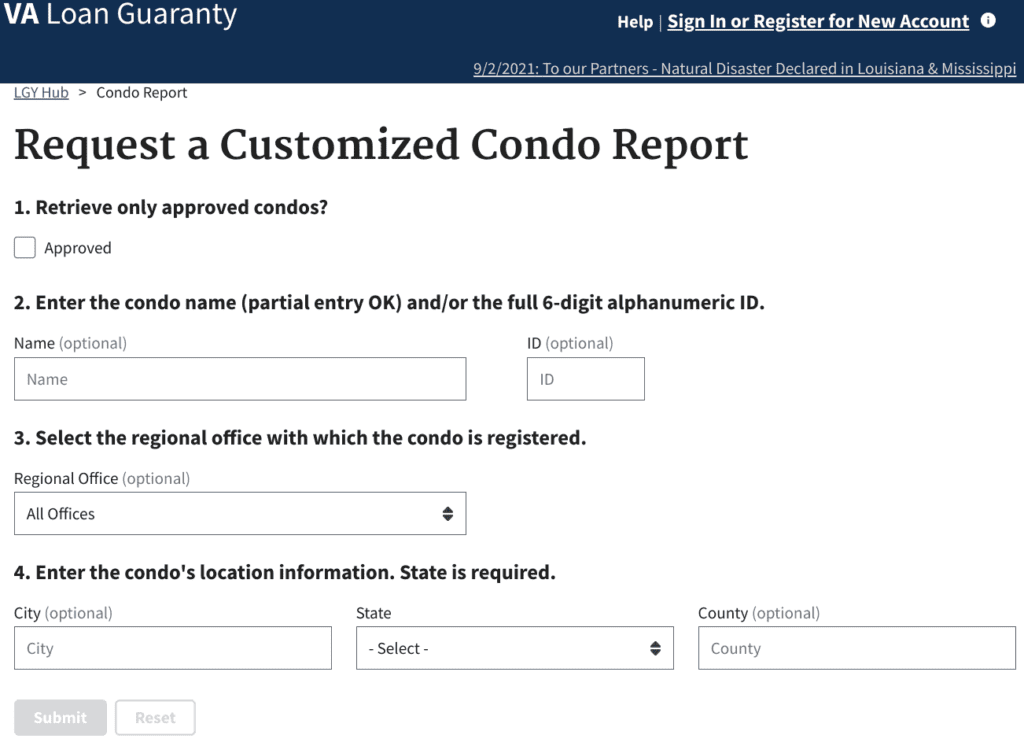
Request a Customized VA Approved Condo Report for Kentucky VA Mortgage Loans. See link below
No Down Payment Requirement on Kentucky VA Jumbo Loans!
What are Kentucky VA Loan Limits?
VA loan limits follow FHFA county loan limits ($510,400 for conforming 1-unit properties in most parts of the country). High Cost county loan limits are now up to $765,600 (1-unit).
To clarify, these “limits” are not a cap on how much your client can borrow – it simply has represented the loan amount that can be borrowed without a down payment. Veterans who can qualify for larger loans can exceed these county limits. Loan amounts exceeding the base conforming limit are considered Jumbo transactions.
Prior to January 1st, all Veterans exceeding base or high cost loan limits were responsible for the additional loan amount in the form of a down payment (25% of the difference between the loan amount and the county loan limit).
The Blue Water Navy Vietnam Veterans Act of 2019 expanded the maximum guaranty amounts for purchase and cash-out loans, enabling eligible* jumbo borrowers to exceed published county loan limits without a down payment requirement!
The VA benefit enhancement now means eligible* Veteran jumbo borrowers may obtain no down payment VA-backed loans in all areas of the country for any home price.
No jumbo credit overlays or loan limits! However, VA jumbo loan amounts exceeding $1,000,000 with 100% LTV will be subject to additional due diligence review before approval.
*Subject to credit approval, requires full entitlement; for purchases and cash-out refinances only and not applicable for loan amounts <= $144,000. For IRRRLs, VA will continue to guarantee 25% of the loan amount without regard to the Veteran’s available entitlement and/or county loan limits.
WHAT ARE THE UPDATED GUIDELINES FOR QUALIFYING FOR A KENTUCKY VA MORTGAGE IN 2020
A Kentucky VA loan is issued by a private lender in Kentucky and insured by the Department of Veterans Affairs or VA . for qualified U.S. veterans, active-duty military personnel and certain surviving spouses.
You were separated from military service in a situation “other than dishonorable discharge.”
As a veteran or active military, you meet specific length-of-service requirements.
You are a reservist or a member of the National Guard.
You are a qualified surviving spouse of a deceased veteran.
In addition, there are these requirements:
The home must be your primary residence.
You must have a valid certificate of eligibility from the VA.
Although the VA has no minimum credit score requirement, most lenders do.
Kentucky VA Mortgage Loan Benefits.
A Kentucky VA loan begins with one important distinction: relaxed credit-qualifying standards in regards to credit scores, past bankruptcies and foreclosures
VA has no minimum credit score requirement, lenders often require scores of at least 580 A few lenders will approve loans with credit scores as low as 500 in some cases .2 year removed from bankruptcy and foreclosure is required too with a clear Cavirs number.
THE MAJOR BENEFITS of a Kentucky VA mortgage are as follows:
$0 down payment unless the purchase price is more than the appraised value of the property or it’s higher than the local VA loan limit.
Mortgage rates are typically lower than rates on conventional loans.
No mortgage insurance is required monthly, just upfront funding fees.
You can reuse your VA loan benefit.
You don’t have to be a first-time home buyer.
VA-backed loans can be assumable — this means they can be taken over by someone you sell the house to, even if that person isn’t a service member.
A bankruptcy discharged more than two years ago — and in some cases, within one to two years — will not preclude you from getting a VA loan.
Types of Kentucky Mortgage VA loans
Home purchase in Kentucky: A Kentucky VA loan can be used to buy an existing home or a condominium in a VA-approved development, or to build a home.
Cash-out refinance in Kentucky: A VA cash-out refi replaces your mortgage with a new loan, while tapping some of your home’s value for things like paying off debt or making home improvements. It also can be used to replace a non-VA loan with a VA loan.
Interest rate reduction refinance loan or rate and term: A VA IRRRL (which is pronounced “Earl”) is also called a streamline refinance loan. You can replace an existing VA loan with a mortgage offering a lower interest rate, or move from an adjustable-rate loan to one with a fixed interest rate. Usually no appraisal or income documentation is needed for most IRRRL Refinances saving you a lot of money and qualifying headaches on a refinance
Although mortgage insurance isn’t charged on Kentucky VA loans, a “funding fee” serves the same purpose: to help lenders defray the expenses of foreclosing on borrowers who default. The fee ranges from 1.25% to 3.3% of the loan balance, depending on your down payment, branch of the military and whether or not it’s your first time getting a VA loan.
The VA funding fee can be rolled into your total loan package, but that will likely raise your interest rate and will absolutely raise your monthly payment.
Though a down payment is not generally required, putting 5% or more down will reduce your VA funding fee. And a down payment will lower your monthly payment, too.
Childcare Expenses
Did you know that VA considers childcare expenses a debt?
VA has given guidance that Borrowers with children age 12 and under must complete and sign a “Child Care Letter”. The lender must obtain the letter from the veteran documenting the childcare expense or detailing why no expense is incurred. Ensure that the current daycare provisions will remain logical based on the location of the new home. If applicable, the name and address of the childcare provider, should be obtained. This expense should be listed under section D, line 29, “Job Related Expense (e.g., child care)” on the VA Loan Analysis.
A “VA Child Care Expense Certification” form can be found on the Fairway website under “Forms & Documents” or by clicking here: VA Child Care Expense Certification
Kentucky VA Guidelines After Bankruptcy And Foreclosure On Waiting Period After Foreclosure
Kentucky VA Loans only have a two year mandatory waiting period after foreclosure, deed in lieu of foreclosure, or short sale for a Veteran to qualify for a Kentucky VA Loan.
Kentucky VA Guidelines After Bankruptcy And Foreclosure On Waiting Period After Chapter 7 and 13
There is a two year mandatory waiting period to qualify for a VA Loan after a Chapter 7 Bankruptcy discharged date and 1 year for A Chapter 13 Bankruptcy
Kentucky VA Loan Process
A list of items needed for underwriting is provided to the buyer based on the buyer’s scenario. Based on the borrower’s scenario, the process is explained which includes the items discussed below such as the VA certificate of eligibility (COE), DD-214, income verification, and more.
How to Apply for a VA Home Loan Certificate of Eligibility (COE)
The first step in getting a VA direct or VA-backed home loan is to apply for a Certificate of Eligibility (COE). This confirms for your lender that you qualify for the VA home loan benefit. Find out how to apply for a COE. Then, choose your loan type and learn about the rest of the loan application process.
How do I prepare before starting my application?
Gather the information you’ll need to apply for your COE. Click on the description below that matches you best to find out what you’ll need:
Veteran
Servicemember
Current or former activated National Guard or Reserve member
Current member of the National Guard or Reserves who has never been activated
Discharged member of the National Guard who was never activated
Discharged member of the Reserves who was never activated
Surviving spouse of a Veteran who died on active duty or who had a service-connected disability
In some cases, you can get your COE through your lender using our Web LGY system. Ask your lender about this option.
By mail
To apply by mail, fill out a Request for a Certificate of Eligibility (VA Form 26-1880) and mail it to the address listed on the form. Please keep in mind that this may take longer than applying online or through our Web LGY system. Download VA Form 26-1880.
Next steps for getting a VA direct or VA-backed home loan
Applying for your COE is only one part of the process for getting a VA direct or VA-backed home loan. Your next steps will depend on the type of loan you’re looking to get—and on your lender (for most loans, the lender will be a private bank or mortgage company; for the Native American Direct Loan, we’ll be your lender).
If you are an individual with disabilities who needs accommodation, or you are having difficulty using our website to apply for a loan, please contact us at 502-905-3708.
Disclaimer: No statement on this site is a commitment to make a loan. Loans are subject to borrower qualifications, including income, property evaluation, sufficient equity in the home to meet Loan-to-Value requirements, and final credit approval. Approvals are subject to underwriting guidelines, interest rates, and program guidelines and are subject to change without notice based on applicant’s eligibility and market conditions. Refinancing an existing loan may result in total finance charges being higher over the life of a loan. Reduction in payments may reflect a longer loan term. Terms of any loan may be subject to payment of points and fees by the applicant Equal Opportunity Lender. NMLS#57916http://www.nmlsconsumeraccess.org/
— Some products and services may not be available in all states. Credit and collateral are subject to approval. Terms and conditions apply. This is not a commitment to lend. Programs, rates, terms and conditions are subject to change without notice. The content in this marketing advertisement has not been approved, reviewed, sponsored or endorsed by any department or government agency. Rates are subject to change and are subject to borrower(s) qualification.




 KENTUCKY VA MORTGAGE LENDER
You must be logged in to post a comment.