

Farm Loans: Kentucky VA Home Loans Overview
Kentucky VA Farm Loan Guidelines: Can You Buy a Farm With a VA Loan?
Can you use a VA loan to buy a farm or acreage property in Kentucky? In many cases, yes — but the property must be primarily residential, there must be a home on the land, and the Veteran must occupy that home as a primary residence.
The big mistake many buyers make is assuming that “VA farm loan” means the VA will finance a working farm business. That is not how the VA home loan program works. VA loans are designed for residential home financing, not commercial farming operations. A Kentucky property with a home, acreage, barns, sheds, fencing, pastures, or stables may still be eligible if the property is residential-first and the appraisal supports it.
Quick answer:
A VA loan may be used to buy a Kentucky farm property when there is a residential dwelling on the land, the Veteran will live in the home as their primary residence, and the loan is not being used to buy a commercial farming business.
Can You Buy a Farm in Kentucky With a VA Loan?
Yes, a Kentucky buyer may be able to use a VA loan to purchase a farm-type property when the transaction is primarily for a residence. The home must be the main purpose of the purchase, and the Veteran must intend to occupy the property as their primary residence.
That means a home on acreage in counties such as Shelby, Spencer, Oldham, Hardin, Nelson, Bullitt, Warren, Madison, Jessamine, or surrounding rural Kentucky areas may be workable if the property is residential in nature and comparable sales support the value.
However, a property that is mainly a commercial farming operation may be a problem. If the value is tied heavily to farm production, livestock, crops, equipment, commercial buildings, or business assets, the deal may not fit VA residential mortgage guidelines.
Kentucky VA Farm Loan Eligibility Rules
For a Kentucky farm or acreage property to work with VA financing, these are the key eligibility points:
- There must be a residential dwelling on the land.
- The Veteran must occupy the home as their primary residence.
- The loan must be for residential purposes.
- The loan cannot be used to purchase a farming business.
- The appraisal must support the property as residential real estate.
- Comparable sales should show similar residential acreage properties in the market.
Does VA Have an Acreage Limit in Kentucky?
No. VA does not set a maximum number of acres for a VA-guaranteed property. This is one of the biggest misconceptions about VA farm and acreage loans.
The real issue is not the number of acres. The real issue is whether the property is primarily residential and whether the appraiser can find comparable sales that support the value.
For example, a house on 10, 20, or even more acres may be acceptable if similar residential acreage properties have sold in the area. But if the only comparable sales are commercial farms or agricultural production properties, the file can become more difficult.
How VA Looks at Barns, Sheds, Stables, Pastures, and Outbuildings
VA may allow value for rural improvements such as barns, sheds, corrals, stables, fencing, and pastures when those improvements contribute to the residential market value of the property.
The key phrase is residential market value. The appraiser is not valuing the property as a farm business. The appraiser is valuing it as residential real estate.
Items VA Does Not Include in Value
For VA loan purposes, the property value cannot include:
- Livestock
- Crops
- Farm equipment
- Farm supplies
- Business inventory
- Commercial farming assets
This matters because some Kentucky farm listings include more than just the house and land. If the sales price includes cattle, hay, tractors, equipment, feed, or other business assets, those items need to be separated from the residential real estate transaction.
Why Comparable Sales Matter on Kentucky Acreage Properties
On a VA farm or acreage property, comparable sales can make or break the deal.
If the appraiser can find recent sales of homes on similar acreage that were sold primarily for residential use, the appraisal is usually more straightforward. If the appraiser has to rely on commercial farm sales, agricultural-use sales, or unique properties with limited market support, the underwriting risk increases.
Before writing an offer on a Kentucky acreage property, it is smart to review:
- How many acres are included
- Whether the home is the main value driver
- Whether barns or outbuildings appear residential or commercial
- Whether the listing includes livestock, crops, equipment, or business assets
- Whether similar homes on acreage have sold nearby
- Whether the property is being marketed as a residence or a working farm business
Can Farm Income Be Used to Qualify for a VA Loan?
Potentially, yes. If some or all of the income needed to qualify comes from farming operations, the lender must verify that the Veteran has the ability and experience to operate the farm.
In real-world underwriting, this usually means the income will be reviewed similarly to self-employment income. The lender will look for documented history, consistency, tax returns, profit and loss information, and whether the income is likely to continue.
Speculative income usually will not work. A buyer saying, “I plan to make money from farming after I buy the property,” is not the same as having stable, documentable farm income already reported and supported.
Farm Income Documentation May Include
- Two years of federal tax returns
- Schedule F or applicable business schedules
- Year-to-date profit and loss statement
- Evidence of farming experience
- Business debt documentation
- Explanation of farm operations
- Documentation that income is stable and likely to continue
Common Kentucky VA Farm Loan Red Flags
Not every rural property will qualify. These are common issues that can create problems:
- The property is primarily a working commercial farm.
- The sales price includes livestock, crops, equipment, or supplies.
- The property has no strong residential comparable sales.
- The barns or outbuildings are clearly commercial-use facilities.
- The value depends heavily on agricultural income production.
- The buyer does not intend to occupy the home as a primary residence.
- The property is being marketed mainly as a business opportunity.
VA vs. FHA vs. USDA for Kentucky Acreage Properties
The right loan program depends on the buyer, the property, the location, and the appraisal support. VA, FHA, and USDA can all work for rural Kentucky properties, but the rules are not identical.
| Loan Program | Acreage Rule | Main Underwriting Focus | Common Deal Killer |
|---|---|---|---|
| VA | No VA-set acreage cap. | Primary residence, residential use, residential comparable sales, and no value assigned to livestock, crops, or equipment. | The property is primarily a commercial farming operation. |
| FHA | No simple universal acreage cap, but land must be marketable and supported by the appraisal. | Residential use, property condition, marketability, excess land issues, and appraisal support. | Commercial or agricultural use dominates the residential use. |
| USDA Guaranteed | Site size must be typical for the area. | Eligible rural location, primary residence, typical site size, and no income-producing land or buildings used principally for income-producing purposes. | Property used primarily for agriculture, farming, or commercial enterprise. |
Kentucky VA Farm Property Pre-Check
If you are looking at a farm, mini-farm, hobby farm, horse property, or home on acreage in Kentucky, the best move is to review the listing before you write an offer.
Send the address or MLS link and I can help look at the practical risk points:
- Does the property appear residential-first?
- Is the acreage likely to be acceptable?
- Are there outbuildings that could create appraisal questions?
- Does the listing include livestock, crops, equipment, or business assets?
- Are there comparable residential acreage sales nearby?
- Does VA, FHA, USDA, or conventional financing make the most sense?
Kentucky VA Farm Property Checklist
Before writing an offer, make sure the property passes these common-sense tests:
- There is a livable residential home on the land.
- The Veteran will occupy the property as a primary residence.
- The purchase is not mainly for a commercial farming business.
- The value is not based on livestock, crops, equipment, or business assets.
- Comparable sales support residential acreage value.
- The contract includes proper VA financing protections.
Steps to Use a VA Loan for a Kentucky Farm or Acreage Property
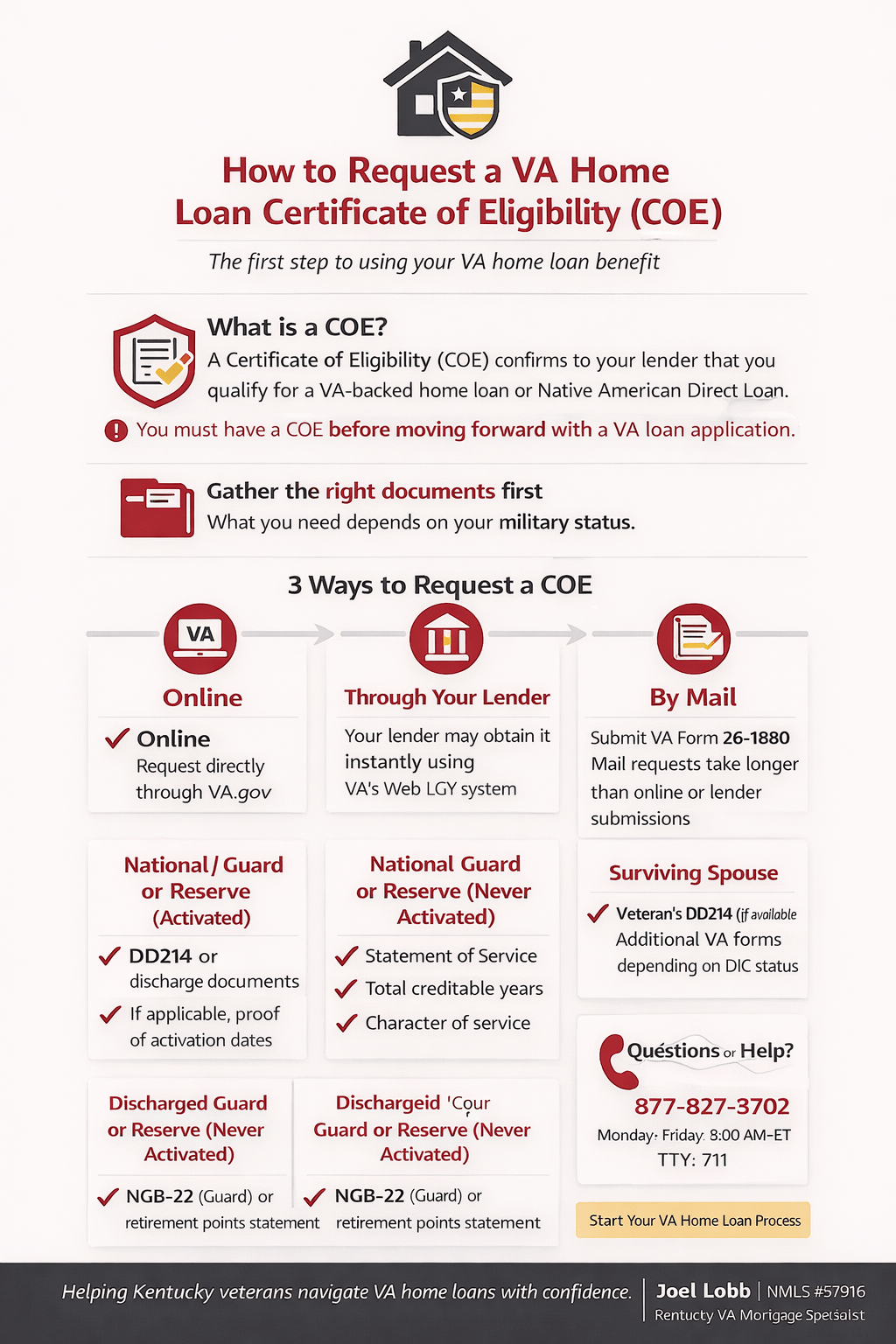
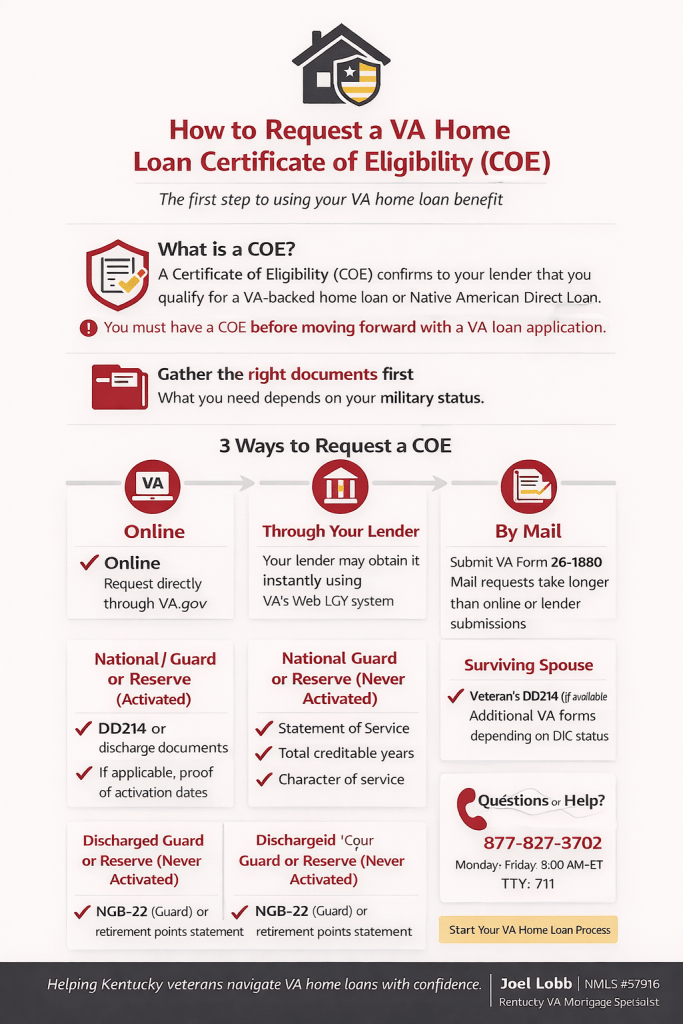
- Get your VA Certificate of Eligibility, also called the COE.
- Complete a VA mortgage pre-approval.
- Send the property address or MLS listing for an early feasibility review.
- Review income, credit, assets, debts, and entitlement.
- Make sure the sales contract is structured correctly for VA financing.
- Order the VA appraisal after the contract is accepted.
- Clear underwriting conditions and close on the home.
FAQ: Kentucky VA Farm Loan Guidelines
Can I use a VA loan to buy a farm in Kentucky?
Yes, in many cases. The property must include a residence, the Veteran must occupy the home as a primary residence, and the loan must be for residential purposes rather than a farming business.
Does VA have a maximum acreage limit?
No. VA does not set a maximum number of acres. The bigger question is whether the acreage is typical for the market and supported by residential comparable sales.
Can barns, sheds, stables, or pastures be included?
Yes, they may be considered if they contribute to residential market value. The VA appraisal cannot include value for livestock, crops, farm equipment, or supplies.
Can I use farm income to qualify for a VA loan?
Possibly. If farm income is needed to qualify, the lender must document the income and verify the Veteran’s ability and experience as a farm operator.
What makes a Kentucky farm property ineligible for VA financing?
A property may be ineligible if it is primarily a commercial farming operation, if the value depends on business assets, or if the property does not support residential use and residential market value.
Should I send the listing before making an offer?
Yes. With acreage properties, it is smart to review the property early. The appraisal, comparable sales, outbuildings, and business-use issues should be considered before you are locked into a contract.
Talk to a Kentucky VA Mortgage Lender
If you are a Veteran, active-duty service member, eligible surviving spouse, National Guard member, or Reserve member looking at a farm, mini-farm, hobby farm, horse property, or home on acreage in Kentucky, I can help you review the loan options before you write an offer.
Call or text Joel Lobb at 502-905-3708 to review your Kentucky VA loan options.
Joel Lobb, Mortgage Broker FHA, VA, KHC, USDA
NMLS #57916
EVO Mortgage | Company NMLS #1738461
Call/Text: 502-905-3708
Email: kentuckyloan@gmail.com
Website: http://www.mylouisvillekentuckymortgage.com
Equal Housing Lender. This is not a commitment to lend. All loans are subject to credit approval, VA eligibility, property approval, appraisal, underwriting, and program guidelines. Not affiliated with, endorsed by, or acting on behalf of the Department of Veterans Affairs, USDA, FHA, HUD, or any government agency.
Official VA and USDA Resources
FAQ: Kentucky VA Farm Loan Guidelines
Can I use a VA loan to buy a farm in Kentucky?
Yes, in many cases. The property must include a residence, the Veteran must occupy the home as a primary residence, and the loan must be for residential purposes rather than a farming business.
Does VA have a maximum acreage limit?
No. VA does not set a maximum number of acres. The bigger question is whether the acreage is typical for the market and supported by residential comparable sales.
Can barns, sheds, stables, or pastures be included?
Yes, they may be considered if they contribute to residential market value. The VA appraisal cannot include value for livestock, crops, farm equipment, or supplies.
Can I use farm income to qualify for a VA loan?
Possibly. If farm income is needed to qualify, the lender must document the income and verify the Veteran’s ability and experience as a farm operator.
What makes a Kentucky farm property ineligible for VA financing?
A property may be ineligible if it is primarily a commercial farming operation, if the value depends on business assets, or if the property does not support residential use and residential market value.



You must be logged in to post a comment.