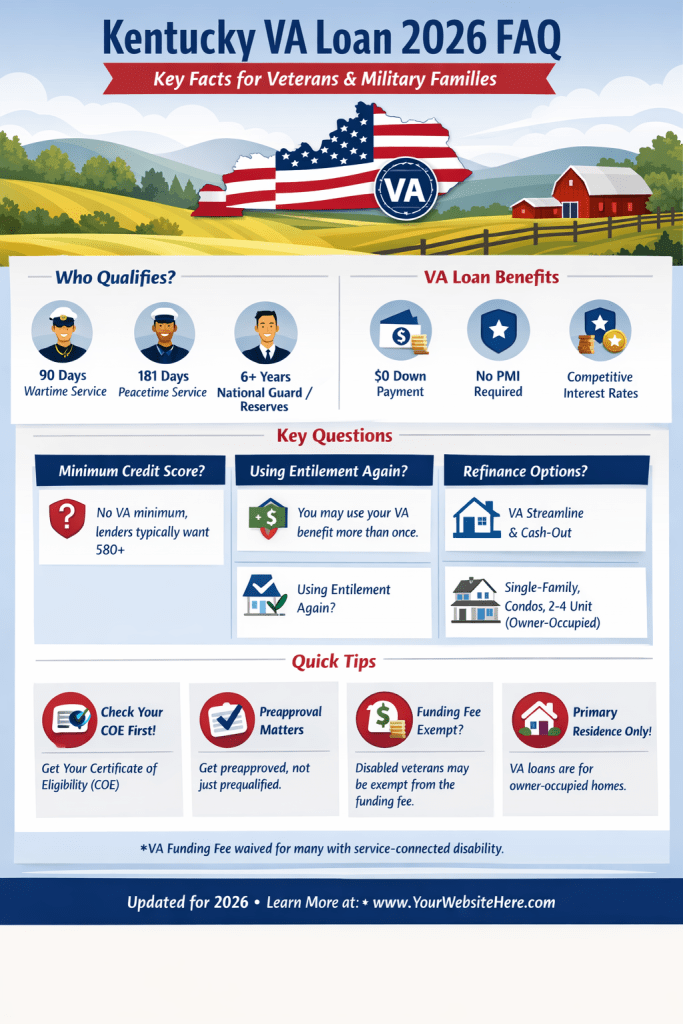

VA home loans in Kentucky • VA IRRRL streamline refinance explained • VA cash-out refinance rules • VA funding fee and closing cost guide

Comprehensive Guide to VA Refinance for Kentucky Veterans


VA Refinance in Louisville Kentucky: Complete Guide to IRRRL, Cash-Out & Rate-and-Term Options

As a Kentucky mortgage lender with over 20 years of experience, I’ve helped more than 1,300 veterans and active military members refinance their VA home loans to save money, access home equity, and achieve better loan terms. If you’re a Louisville area veteran with an existing VA mortgage, understanding your refinance options could save you thousands of dollars over the life of your loan.

This comprehensive guide covers the three main VA refinance options available to Kentucky veterans: VA Interest Rate Reduction Refinance Loans (IRRRL), cash-out refinancing, and rate-and-term refinancing.

Ready to Explore Your Refinance Options?

Get a free pre-qualification and see your refinance options today. Same-day approvals on most applications.Call or Text: 502-905-3708Email: kentuckyloan@gmail.com

What is a VA Refinance Loan?

A VA refinance loan allows veterans who already have a VA mortgage to refinance their existing home loan into new terms. Unlike traditional cash-out refinancing, VA refinancing leverages your existing VA home loan entitlement, making the process faster and more affordable.

Why refinance your VA mortgage?

  • Lower monthly payments through reduced interest rates
  • Access home equity with cash-out refinancing for home improvements, debt consolidation, or other expenses
  • Shorter loan terms to pay off your mortgage faster
  • Convert ARM to fixed-rate mortgages for payment stability
  • Eliminate PMI with no requirement for mortgage insurance

If you’re curious about whether refinancing makes sense for your specific situation, contact me at 502-905-3708 for a free, no-obligation consultation.

Understanding VA Loan Entitlement for Refinancing

Before exploring specific refinance programs, it’s important to understand your VA loan entitlement. Your entitlement is your “eligibility” to use the VA loan benefit.

Key entitlement facts:

  • The basic entitlement available to each eligible veteran is $36,000
  • If you’ve already used your entitlement for a previous VA purchase, you can reuse it for a refinance
  • A Certificate of Eligibility (COE) from the VA proves you’ve used your entitlement before
  • Lenders can verify entitlement status without requiring a new COE in some cases

For IRRRL refinances specifically: You only need to certify that you previously occupied the home—the occupancy requirements are different from purchase loans.

Uncertain about your entitlement status? I can help you determine your eligibility and available options at no cost. Call or text 502-905-3708 or email kentuckyloan@gmail.com.

VA IRRRL Refinance (Interest Rate Reduction Refinance Loan) – The Streamline Option

The VA Interest Rate Reduction Refinance Loan (IRRRL), also called a VA streamline refinance, is the fastest and simplest way for veterans to lower their interest rate and reduce monthly payments.

How Does a VA IRRRL Streamline Refinance Work?

The IRRRL is designed specifically to refinance an existing VA-to-VA mortgage into better terms. The VA guarantees the new loan just as it did your original mortgage, which means lenders can approve IRRRLs with minimal paperwork.

The streamline advantage:

  • No appraisal required
  • No underwriting/credit check required
  • No Certificate of Eligibility (COE) needed (though you can provide one)
  • Loan can be approved in as few as 7-10 business days
  • All closing costs can be rolled into the new loan amount
  • Minimal documentation needed

IRRRL Eligibility Requirements

To qualify for a VA IRRRL streamline refinance, you must meet these basic criteria:

  1. You already have a VA loan – The IRRRL is only for refinancing an existing VA mortgage
  2. VA-to-VA refinance – You’re refinancing a VA loan into another VA loan (you cannot use IRRRL to refinance into a conventional or FHA loan)
  3. You previously occupied the home – Unlike purchase loans, you don’t need to occupy the property now; you just need to certify you did in the past
  4. Your entitlement must be available – If you’ve used your full entitlement for another property without paying off the original loan, you may have limited options

Subordination requirement: If you have a second mortgage (home equity line of credit, second lien, etc.), the holder must agree to subordinate (place) that loan below your new VA mortgage. If they won’t, the IRRRL may not be possible.

IRRRL Closing Costs & Funding Fee

One of the biggest advantages of IRRRL refinancing is the ability to do it with “no money out of pocket” by rolling all costs into the new loan amount.

Typical IRRRL costs include:

  • VA funding fee (reduced for IRRRL – typically 0.55% of the loan amount)
  • Title insurance and title search
  • Recording fees and transfer taxes (varies by county)
  • Appraisal fee (if lender requires one, though not mandatory)
  • Loan origination fee

VA Funding Fee Exemptions

You do NOT pay a funding fee if you are:

  • A veteran receiving VA compensation for a service-connected disability
  • A veteran entitled to receive compensation for a service-connected disability (even if receiving military retirement pay)
  • A surviving spouse of a veteran who died in service or from a service-connected disability

Real-world example: On a $200,000 IRRRL refinance, a typical VA funding fee of 0.55% equals $1,100. If closing costs total $3,500, the entire amount can be rolled into your new loan, meaning zero cash at closing.

IRRRL Rate Reduction Rule – Do You Have Enough Savings?

The VA doesn’t require a minimum rate reduction for an IRRRL, but lenders do. Most lenders require a “net tangible benefit,” which typically means:

  • At least 0.5% rate reduction, though
  • 1% or more is ideal to ensure meaningful monthly savings

Important warning: Some lenders promote the IRRRL as a way to reduce your loan term from 30 years to 15 years. This can dramatically increase your monthly payment, even with a lower interest rate. For example:

  • Current: 30-year loan at 4.5% on $200,000 = $1,013/month
  • Refinance: 15-year loan at 3.5% on $200,000 = $1,428/month (a $415 monthly increase!)

While you’d save interest over time, this payment increase might not be affordable. Always run the numbers carefully before pursuing a shorter loan term.

IRRRL Application Process – Timeline & Steps

  1. Submit application – Basic loan application (NMLS Form 1003 or lender-specific form)
  2. Verification – Lender confirms previous VA entitlement use (may contact VA directly)
  3. Appraisal (if required) – Most lenders skip this; if needed, typically 3-5 days
  4. Processing – Lender prepares documents and underwriting report (3-5 business days)
  5. Approval – Clear to close, no conditions (typically days 7-10)
  6. Closing – Sign documents and fund the loan
  7. Funding – New loan funds and existing mortgage is paid off

Fast approval: Most IRRRLs receive approval in 7-14 days with my office.

VA Cash-Out Refinance Loans – Access Your Home Equity

A VA cash-out refinance allows you to refinance your existing VA mortgage for more than you currently owe and receive the difference in cash. This is ideal for home improvements, debt consolidation, education expenses, or other major financial needs.

How Does a VA Cash-Out Refinance Work?

When you do a cash-out refinance, your new VA loan amount includes:

  1. The balance you owe on your existing mortgage
  2. Plus additional funds you’re borrowing (the “cash-out” amount)
  3. Closing costs (which can be rolled into the loan)

Example: If your home is worth $250,000 and you owe $150,000, a VA cash-out refinance could allow you to borrow up to $200,000 or more, receiving $50,000+ in cash while refinancing your original debt.

The new loan is still a VA loan with the same benefits: no down payment, no PMI, and VA guarantee protection.

VA Cash-Out Refinance Eligibility

Cash-out refinancing has slightly stricter requirements than IRRRL:

  1. You must have a VA loan to refinance
  2. Loan-to-Value (LTV) limits apply – Generally, lenders allow cash-out up to 80% LTV (meaning your loan can be 80% of your home’s current value)
  3. Your home must appraise – Unlike IRRRL, appraisals are required for cash-out loans
  4. Income verification – Full underwriting including employment verification, credit review, and income documentation
  5. Debt-to-income ratio – Your total monthly debt (including the new mortgage) cannot typically exceed 43-50% of gross income
  6. Credit score – Minimum 580-620 FICO score (though better rates with 660+)

VA Cash-Out Refinance Uses & Benefits

Common uses for cash-out refinancing:

  • Home improvements – Roof repairs, additions, kitchen remodels, HVAC systems
  • Debt consolidation – Pay off credit cards, personal loans, or medical debt at a lower rate
  • Education expenses – Fund college tuition or vocational training
  • Emergency expenses – Major home repairs or family emergencies
  • Investment – Real estate investments or business opportunities
  • Vehicle purchase – Consolidate auto loans into one lower-rate mortgage

The math of consolidation: If you have $25,000 in credit card debt at 18% APR ($450/month), refinancing into a VA cash-out loan at 6% APR could drop your payment to $150/month while rebuilding your credit faster.

VA Cash-Out Refinance Loan Limits by County

VA doesn’t cap how much you can borrow, but lenders set limits based on:

  • Your VA entitlement and available entitlement
  • Your home’s appraised value
  • Your income and credit qualifications

Jefferson County (Louisville) Loan Limits: For 2026, contact me for exact loan limits in your county, as they update annually. Generally, standard VA loans have no cap on borrowing, with limits applied based on your entitlement and the property value. To maximize your borrowing without a down payment, ensure you have sufficient available entitlement.

VA Cash-Out Timeline & Process

Cash-out refinancing takes longer than IRRRL because:

  • Appraisal required – 7-10 days
  • Full underwriting – 5-10 days
  • Verification of employment/income – 2-5 days
  • Clear to close – 2-5 days

Total timeline: 21-30 days, though my office frequently closes cash-out loans in 18-21 days.

VA Rate-and-Term Refinance – Traditional Refinancing

A rate-and-term refinance is a middle ground between IRRRL and cash-out refinancing. You refinance your existing loan without borrowing additional cash, but at a better interest rate or different term.

How Does Rate-and-Term Refinancing Work?

In a rate-and-term refinance:

  • Your new loan amount is approximately equal to what you currently owe (plus closing costs)
  • You’re not taking cash out
  • Your loan term can change (e.g., 30 years to 20 years)
  • Your interest rate is refinanced at current market rates

When to use rate-and-term refinancing:

  • You need a better rate than IRRRL allows
  • You’re converting an ARM (adjustable-rate) to a fixed-rate mortgage
  • You want to shorten your loan term without taking cash out
  • You prefer not to go through full cash-out underwriting

Rate-and-Term Eligibility

Rate-and-term refinancing sits between IRRRL and cash-out in terms of underwriting:

  • Some lenders require simplified underwriting (not full)
  • Appraisals may or may not be required
  • Income verification typically required
  • Credit check is standard
  • Debt-to-income limits apply (usually 43-50%)

When to Choose Rate-and-Term vs. IRRRL

FactorIRRRLRate-and-Term
Rate reduction requiredUsually 0.5%+Can refinance at higher rate if needed
UnderwritingMinimal – streamlinedModerate – some verification
Timeline7-14 days15-25 days
Closing costs~$2,500-3,500~$3,500-5,000
Best forFaster, easier refisMore flexibility, specific goals
ARM to fixedYesYes

Comparison: IRRRL vs. Cash-Out vs. Rate-and-Term

FeatureIRRRLCash-OutRate-and-Term
No appraisal✗ (required)~ (varies)
No underwriting✗ (full)~ (simplified)
Access cash
Fastest approval✓ (7-10 days)✗ (21-30 days)~ (15-25 days)
Best rate✓ (usually)~~
FlexibilityLimitedHighModerate
Funding fee0.55%0.55%+0.55%+
Occupancy requirementPrevious onlyCurrent propertyCurrent property

VA Funding Fees Explained – What You’ll Pay

All VA refinances include a funding fee (unless you’re exempt due to service-connected disability):

2026 VA Funding Fee Rates for Refinancing

For IRRRL (streamline) refinances:

  • First-time refinancers, no down payment: 0.55% of loan amount
  • Subsequent refinancers, no down payment: 0.55% (same as IRRRL)
  • National Guard/Reserve: Slightly higher (about 0.575%)

For cash-out and rate-and-term refinances:

  • First-time, no down payment: 2.3% of loan amount
  • Subsequent users, no down payment: 3.6% of loan amount
  • National Guard/Reserve: Higher percentages apply

Funding Fee Example:
• $200,000 IRRRL with 0.55% fee = $1,100
• $200,000 cash-out with 2.3% fee = $4,600

The good news? You can finance the funding fee into your new loan, so you don’t need to pay cash at closing.

Funding Fee Exemptions – You Might Not Pay

You’re exempt from the VA funding fee if you:

  1. Receive VA disability compensation for a service-connected disability (any percentage)
  2. Are entitled to receive compensation for service-connected disability but receive military retirement/active duty pay instead
  3. Are a surviving spouse of a veteran who died in service or from service-connected disability

If you’re exempt, provide VA documentation (VA letter of eligibility, DD Form 214, or similar) to your lender.

VA Loan Entitlement & Limits for Louisville, Kentucky

Your VA entitlement determines how much you can borrow without a down payment. The basic entitlement is $36,000, but if you have significant available entitlement, you can borrow much more.

How Entitlement Works

Example:
• Basic entitlement: $36,000
• If your home value is $250,000 and you’re fully qualified:
• You can borrow up to 4x your available entitlement without a down payment
• $36,000 × 4 = $144,000 maximum
• So lenders would typically fund up to $144,000 without requiring a down payment

However, if you have a higher purchase price or the property appraises for more, you may need to put money down.

For refinancing: Your available entitlement is what matters. If you have restored entitlement (paid off a previous VA loan), you have more borrowing capacity.

Jefferson County, Kentucky Loan Limits (2026)

Contact me for exact loan limits in your county, as they update annually. Generally:

  • Standard VA loans: No cap on borrowing
  • Loan limits apply based on your entitlement and income qualification
  • To maximize your borrowing without a down payment, ensure you have sufficient available entitlement

Common VA Refinance Questions Answered

Do I Need a Certificate of Eligibility for an IRRRL?

No, a new Certificate of Eligibility (COE) is not required for IRRRL refinances. Your lender can verify entitlement through the VA’s online system. However, if you have your COE handy, you can provide it to speed up verification.

Can I Refinance an ARM (Adjustable-Rate Mortgage) with VA?

Yes! Converting an ARM to a fixed-rate VA mortgage is a common and smart use of IRRRL or rate-and-term refinancing. When interest rates are low, this can lock in predictable payments for 30 years.

How Much Will My Monthly Payment Drop?

The payment reduction depends on:

  1. Interest rate reduction – Each 1% lower rate saves roughly $215/month per $100,000 borrowed
  2. Loan term – Shorter terms = higher payments but less total interest
  3. Loan amount – Larger loans have proportionally larger payment changes

Quick calculation: Refinancing $150,000 from 5% to 4% typically saves ~$165/month.

Can I Refinance if I Have Bad Credit?

Yes, VA refinancing is more flexible than conventional financing:

  • IRRRL: No credit check required
  • Cash-out/Rate-and-term: Minimum credit score typically 580-620
  • Even with recent delinquencies, many veterans qualify

If you have credit concerns, discuss them with me. I’ve helped veterans with bankruptcies, foreclosures, and late payments refinance successfully.

How Long Does Refinancing Take?

  • IRRRL: 7-14 days (fastest)
  • Rate-and-term: 15-25 days
  • Cash-out: 21-30 days

My office often beats these timelines with efficient processing.

What Happens to My Current Mortgage During Refinancing?

Your old mortgage remains active until the new loan funds and pays it off. Once the new loan closes:

  1. The new lender sends funds to the old lender
  2. Old mortgage is paid off in full
  3. Your home title is transferred to the new lender
  4. You begin payments on the new mortgage

There’s no gap in coverage or risk of losing your home.

VA Refinance Success Stories from Louisville Veterans

Over 20+ years, I’ve helped thousands of Kentucky veterans refinance. Here are real-world examples:

Example 1 – IRRRL Streamline Savings

Jim’s Story: Jim, a Louisville veteran, had a VA mortgage at 5.5% on $180,000. When rates dropped to 4.25%, he did an IRRRL refinance in just 10 days. His monthly payment dropped from $1,022 to $886—saving him $136/month or $1,632/year. No appraisal, no underwriting. Clean and simple.

Example 2 – Cash-Out for Home Improvement

Maria’s Story: Maria, a Fort Knox-area veteran, had $280,000 owed on her home valued at $380,000. She refinanced with a $300,000 VA cash-out loan, receiving $20,000 to renovate her kitchen and update the home’s electrical system. Her payment only increased $150/month while adding home value and equity.

Example 3 – ARM to Fixed-Rate Security

David’s Story: David’s VA ARM mortgage was set to adjust upward from 3.8% to 5.2%. Before the adjustment, he refinanced into a 30-year fixed VA loan at 4.3%, locking in stability. His payment actually decreased while eliminating the risk of rising rates.
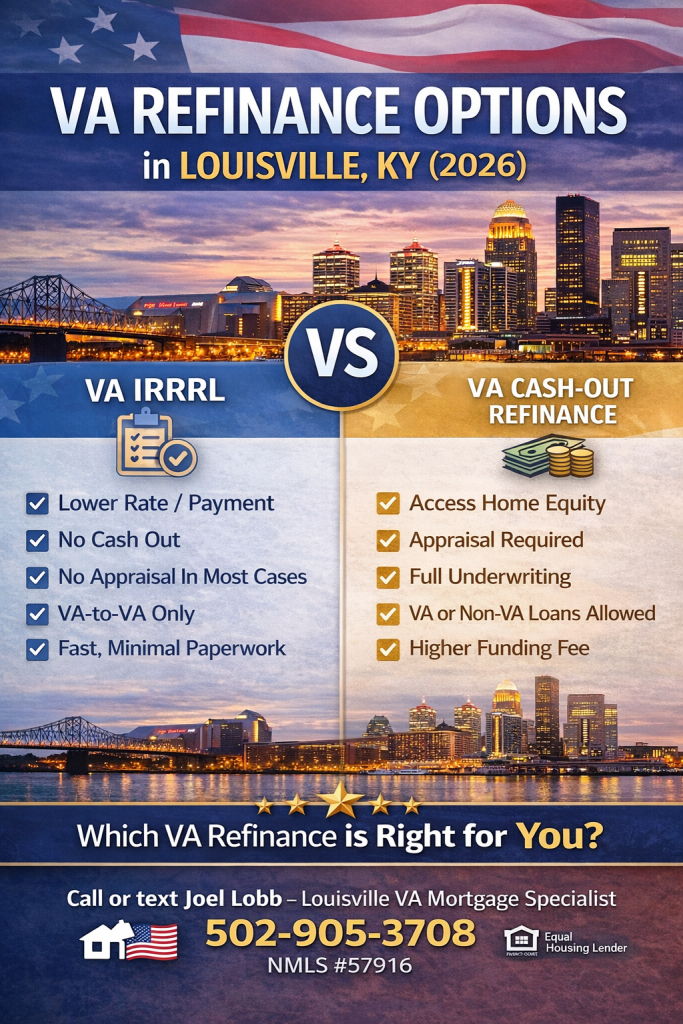
This comprehensive guide covers the three main VA refinance options available to Kentucky veterans: VA Interest Rate Reduction Refinance Loans (IRRRL), cash-out refinancing, and rate-and-term refinancing.

Why Work With Me for Your VA Refinance?

I’m Joel Lobb, NMLS #57916, and I’ve spent 20+ years specializing in Kentucky VA mortgages. Here’s what sets my service apart:

  • ✓ Local expertise – I know Louisville, Jefferson County, Fort Knox, and all 120 Kentucky counties
  • ✓ Fast approvals – Same-day pre-approval on most applications; average close in 18-21 days
  • ✓ Transparent guidance – I explain all options without pressure and help you choose what’s best for YOUR situation
  • ✓ Personal service – I answer my phone and attend most closings personally
  • ✓ 1,300+ families helped – Over two decades of proven success
  • ✓ Free pre-qualification – No hidden fees, no commitment
  • ✓ 24/7 accessibility – Call or text me anytime

Your Next Steps

Ready to explore your refinance options?

  1. Call or text me at 502-905-3708 – I’ll discuss your current mortgage and goals
  2. Send your information to kentuckyloan@gmail.com – I’ll analyze your situation and options
  3. Complete a free pre-qualification – Same-day approvals on most applications
  4. Lock in your rate – Secure the best rate available

No pressure. No obligation. Just honest guidance from a Kentucky veteran mortgage expert.

Ready to Start Your VA Refinance?

Get a free pre-qualification today and discover how much you could save with VA refinancing.📞 Call or Text: 502-905-3708📧 Email: kentuckyloan@gmail.com🌐 Visit: http://www.kentuckyvamortgage.com

Important Disclaimers

This website and content are not endorsed by the VA, FHA, USDA, or any government agency. They are provided for educational purposes only.

Loan qualification: All loans are subject to:

  • Income verification and credit approval
  • Property appraisal and valuation (when required)
  • Sufficient equity (LTV requirements)
  • Debt-to-income ratio limits
  • Final underwriting approval

Rate changes: Interest rates are subject to market conditions and change daily. Rates mentioned are examples only.

Equal Housing Opportunity: I am an Equal Housing Lender. I serve all applicants fairly regardless of race, color, national origin, religion, sex, familial status, or disability.

No statement on this site is a commitment to make a loan. Loans are subject to borrower qualifications, including income, property evaluation, sufficient equity in the home to meet Loan-to-Value requirements, and final credit approval. Approvals are subject to underwriting guidelines, interest rates, and program guidelines and are subject to change without notice based on applicant’s eligibility and market conditions. Refinancing an existing loan may result in total finance charges being higher over the life of a loan. Reduction in payments may reflect a longer loan term. Terms of any loan may be subject to payment of points and fees by the applicant. Equal Opportunity Lender.

NMLS#57916 | http://www.nmlsconsumeraccess.org/

Contact Information

Joel Lobb
Senior Loan Officer – Kentucky VA Mortgage Specialist
NMLS #57916 | Company NMLS #1738461
American Mortgage Solutions, Inc.

📞 Call/Text: 502-905-3708 (available 7 days a week)
📧 Email: kentuckyloan@gmail.com
🌐 Website: www.kentuckyvamortgage.com

Serving all 120 counties in Kentucky – Louisville, Lexington, Bowling Green, Owensboro, Covington, and beyond.

Same-day pre-approvals | Fast closings | Personal service | Expert guidance
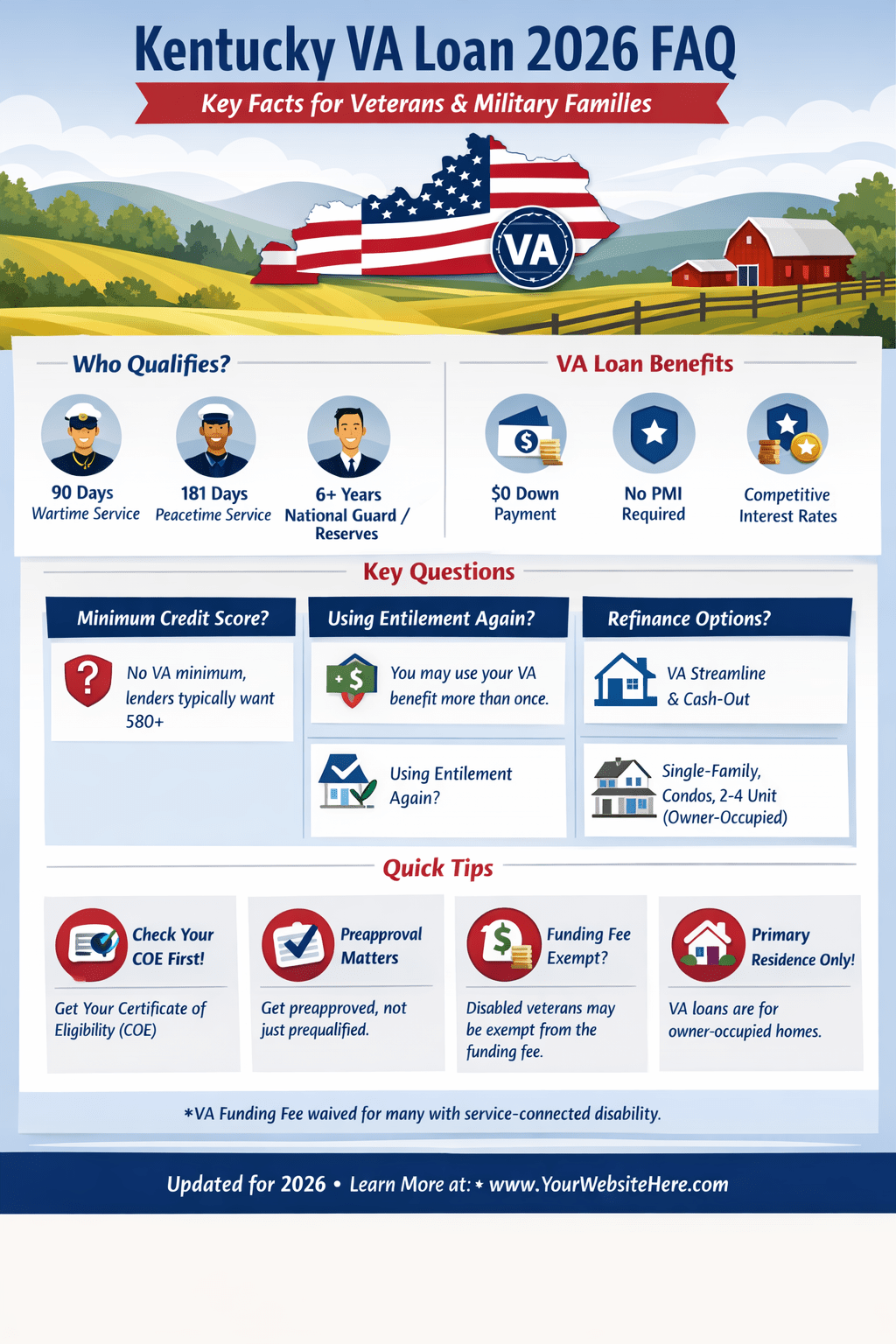
Answers to the most common Kentucky VA loan questions in 2026. Learn who qualifies, credit score rules, entitlement, funding fees, rates, and how to use your VA home loan benefit in Kentucky

Kentucky VA Loans 2026: Your Ultimate FAQ Guide


Kentucky VA Loan Guide • Updated for 2026

Most Asked Questions About Kentucky VA Loans (2026 FAQ)

If you’re a veteran, active duty service member, or surviving spouse in Kentucky, the VA loan can be one of the strongest paths to homeownership. This 2026 FAQ answers the questions buyers ask the most—eligibility, credit, income, entitlement, funding fee, rates, assumptions, and refinancing.

Quick Take (tell-it-like-it-is)

  • Eligibility means you earned the benefit. Approval means you meet lender underwriting.
  • VA doesn’t set a minimum credit score, but lenders often do.
  • VA loans are for primary residences—no rentals or vacation homes.
  • Funding fee applies unless you’re exempt (often due to service-connected disability).

Table of Contents

  1. VA Loan Eligibility
  2. Entitlement & Using Your Benefit More Than Once
  3. Qualification: Credit, Income, DTI & Residual Income
  4. Rates, Closing Costs & the VA Funding Fee
  5. VA Loan Guidelines & Common Rules
  6. VA Refinance Options
  7. What Types of Homes You Can Buy
  8. Next Steps (Prequal → Preapproval)
  9. Disclosures

VA Loan Eligibility (2026)

What is VA loan entitlement?

VA loan entitlement is the portion of your VA benefit that backs (guarantees) a percentage of your mortgage for an approved lender. The VA does not issue home loans directly—lenders do—while the Department of Veterans Affairs provides the guaranty that makes $0 down and no PMI possible. In 2026, veterans with full entitlement are not subject to county loan limits for a primary residence, but you still must qualify based on income, credit, and the home’s appraised value.

Am I eligible as a surviving spouse?

Many surviving spouses are eligible for VA home loan benefits. Common eligibility paths include:

  • Unmarried surviving spouse of a veteran who died on active duty or from a service-connected disability
  • Surviving spouses who remarried after age 57 and on/after December 16, 2003 may remain eligible
  • Spouse of an active-duty service member who is MIA or POW for 90+ days may be eligible for one-time use

Surviving spouses may also be eligible for VA refinancing options in some circumstances, including VA Streamline (IRRRL).

How do I get my Certificate of Eligibility (COE)?

The COE is the official proof of your eligibility and entitlement. Most lenders can retrieve it electronically in minutes. Veterans can also request the COE through the VA, which may take longer. Bottom line: you can’t close a VA loan without a COE.

Who is eligible for a VA loan?

You may be eligible if any one of the following is true:

  • 90 days of active duty during wartime
  • 181 days of active duty during peacetime
  • 6 years in the National Guard or Reserves
  • Eligible surviving spouse

Eligibility vs. prequalification vs. preapproval

Eligibility confirms you earned the VA benefit. Prequalification is an initial estimate of buying power. Preapproval is the stronger, document-backed step that real estate agents and sellers take seriously. If you’re shopping in Kentucky, aim for preapproval—not just a quick prequal—before making offers.

Entitlement & Using Your VA Loan More Than Once

How does entitlement work in 2026?

Entitlement generally has two layers (basic and bonus) that together determine the VA guaranty. If you’ve used your VA loan before, you may still have remaining entitlement available. Prior use does not automatically block another VA purchase—structure matters.

How do I restore my VA entitlement?

Full entitlement is commonly restored when you sell the home and the VA loan is paid off. You then request restoration through the VA (typically with VA Form 26-1880), along with documentation showing payoff. In limited cases, a one-time restoration may apply.

What is “second-tier” entitlement?

Second-tier entitlement can help veterans buy again after prior VA loan usage or even a foreclosure history. Depending on remaining entitlement and purchase price, a down payment may be needed. This is where a lender who understands VA structure makes a difference.

Can I use a VA loan for a second home or rental property?

No. VA loans are designed for owner-occupied primary residences. You must intend to occupy the home as your primary residence within a reasonable time after closing.

Qualification: Credit, Income, DTI & Residual Income

Who sets VA loan guidelines: the VA or my lender?

The VA sets minimum standards. Lenders add overlays. VA does not publish a minimum credit score, but most lenders use a benchmark. You must satisfy both VA requirements and the lender’s underwriting rules to get approved.

If I have bad credit, can I still get a VA loan?

Possibly. Here’s the straight answer: poor credit can be worked around in some cases, but it depends on the overall risk profile—income stability, residual income, payment history, and how recent the credit events are. “Quick fixes” usually fail; documented improvement and a clean recent history work.

Can someone else sign on the loan with me?

VA co-borrowers are restricted. In most cases, the co-borrower must be your spouse or another eligible veteran. Parents, friends, or significant others who are not eligible veterans typically cannot co-borrow on a VA loan.

What income can I use to qualify?

Lenders verify that you have stable, reliable income and enough residual income after housing and debts. Common income sources include:

  • Military base pay and allowances (including BAH, when stable and likely to continue)
  • Non-military employment
  • Retirement and disability income
  • Self-employment (with additional documentation)
  • Commissions, overtime, bonus income (typically needs a 2-year history)
  • Spouse’s income, alimony/child support (when documentable and expected to continue)

How long after bankruptcy or foreclosure can I qualify?

Bankruptcy and foreclosure do not automatically disqualify you, but timing matters. Many lenders look for about 2 years after Chapter 7 discharge or foreclosure. Chapter 13 may be possible after 12 months of on-time plan payments with trustee approval, depending on the lender. Overlays apply—this is not one-size-fits-all.

Do I need tax returns to apply?

Not always. Many borrowers can qualify without providing tax returns, because lenders can use IRS transcripts and W-2/paystub documentation. Self-employed or commission-heavy income usually requires tax returns and additional paperwork.

Rates, Closing Costs & the VA Funding Fee (2026)

What fees should I expect to pay?

VA limits certain charges to protect veterans from excessive lender fees. Typical costs include title/settlement fees, appraisal, credit report, and the VA funding fee (unless you’re exempt). Sellers can contribute up to a set amount in concessions, which may help reduce your cash to close.

What is the VA funding fee?

The VA funding fee is a one-time fee that helps keep the VA loan program running and replaces monthly mortgage insurance. The fee varies based on loan type (purchase/refi), down payment (if any), and whether it’s first-time or subsequent use. Many veterans with service-connected disability ratings are exempt from the funding fee.

Funding fee (typical structure)

Funding fee percentages can change. For the most current official funding fee chart, reference the VA’s site: VA funding fee & closing costs (official VA).

If you want, we can estimate your funding fee based on your COE status and the exact structure of the loan.

How are VA loan rates determined?

Rates are driven by broader markets (especially bonds) and by your risk profile (credit, down payment, occupancy, property type). Rate pricing can change daily. If you’re shopping seriously, timing your lock strategy matters.

Does my credit score affect my VA loan rate?

Yes. Even with VA’s flexibility, stronger credit typically improves pricing and reduces lender conditions. If your scores are borderline, improving them before you lock can materially reduce the total cost over time.

Does the VA loan offer adjustable rates?

Some lenders offer VA ARMs (adjustable-rate mortgages). They can make sense for short-term ownership plans (common with relocations), but they are not the default best option for most buyers.

VA Loan Guidelines & Common Rules

Can I borrow more than the home’s value?

On purchases, VA financing is tied to the appraised value and allowable costs. Cash-back is limited on purchases. For refinances, VA Cash-Out can allow high loan-to-value in certain scenarios, subject to lender guidelines.

Can I have more than one VA loan at a time?

Sometimes, yes—typically tied to legitimate occupancy needs (relocation, deployments, job moves). Most veterans have one VA loan at a time, but multiple VA loans can be possible depending on remaining entitlement and circumstances.

What is the maximum VA home loan?

VA does not set a maximum loan amount for borrowers with full entitlement. Your maximum is determined by income qualification, residual income, credit, and the property’s appraised value.

Are VA loans assumable?

Yes. VA loans are assumable, which means a qualified buyer may be able to take over the existing rate and terms. Assumability can be a major resale advantage in higher-rate environments, but the buyer must qualify and the servicer must approve the assumption.

Can I pay off a VA loan early?

Yes. VA loans do not have a prepayment penalty. You can pay extra principal or pay off the loan early without lender penalties.

When is a VA loan NOT the best option?

VA is the strongest fit for most eligible buyers—especially those using $0 down. That said, if you have a large down payment and exceptional credit, conventional financing can sometimes compete on pricing. The best move is a side-by-side comparison, not an assumption.

VA Refinancing (2026)

Can the VA loan help lower my monthly bills?

VA has two primary refinance options:

  • VA IRRRL (Streamline): Designed to reduce rate/payment on an existing VA loan with lighter documentation.
  • VA Cash-Out Refinance: Refinance and potentially access equity; can also refinance a non-VA loan into VA if eligible.

Streamlines can sometimes be completed without an appraisal, depending on lender policy.

Can I refinance into a VA loan if I don’t currently have one?

Yes. Eligible veterans can refinance a conventional or FHA mortgage into a VA loan using the VA Cash-Out refinance program (even if you’re not taking cash out), subject to underwriting and lender guidelines.

What Types of Homes Can I Buy With a VA Loan?

You can typically use a VA loan in Kentucky to:

  • Buy a primary residence (single-family home)
  • Buy a VA-approved condo
  • Buy up to a 4-unit property (one unit must be owner-occupied)
  • Build a home (with additional requirements)
  • Buy and improve a home in certain scenarios

You cannot use a VA loan to buy a vacation home or an investment property you won’t occupy as your primary residence.

Helpful VA resource: VA home loans overview (official VA)

Next Steps: Prequal → Preapproval

Fast, clean plan to get approved

  1. Confirm eligibility by pulling your COE (we can usually do this quickly).
  2. Review income, debts, and residual income to set a realistic price range.
  3. Run a preapproval (not just a prequal) before you start writing offers.
  4. Discuss funding fee exemption and closing cost strategies (seller concessions, credits, etc.).

Related Kentucky VA Loan Resources

If you’re not sure whether VA is the best fit, we can run a side-by-side comparison and make the decision based on numbers—not guesswork.

Disclosures

Not affiliated with or acting on behalf of the U.S. Department of Veterans Affairs. Information is educational and subject to change. Loan approval is based on underwriting guidelines, credit, income, assets, property eligibility, and program requirements. Restrictions may apply.

NMLS #57916 | Company NMLS #1738461
Equal Housing Lender

Answers to the most common Kentucky VA loan questions in 2026. Learn who qualifies, credit score rules, entitlement, funding fees, rates, and how to use your VA home loan benefit in Kentucky
Kentucky VA Mortgage Lender

how to get approved for a Kentucky va mortgage loan


Looking to buy a home in Kentucky? VA loans could be your ticket to affordable homeownership. These loans are available to veterans, active-duty service members, and even some surviving spouses.

They’re especially popular because they offer perks like no down payment and competitive interest rates. Whether you’re eyeing a property in Louisville, Lexington, or near Fort Knox, a VA loan can make the process smoother. Plus, Kentucky’s got some great regional benefits for veterans that you might want to check out. Let’s dive into what makes Kentucky VA mortgage lenders a top choice for many.

Key Takeaways

  • VA loans in Kentucky offer no down payment options, making homeownership more accessible.
  • Veterans and active-duty members can benefit from competitive interest rates and flexible credit requirements.
  • Kentucky offers regional benefits for veterans, enhancing the appeal of VA loans in areas like Louisville and Lexington.
  • Understanding the eligibility criteria, including service and credit score requirements, is crucial for a successful application.
  • Working with a VA-approved lender simplifies the loan process, ensuring veterans get the most out of their benefits.

Understanding Kentucky VA Mortgage Lenders

Key Features of VA Loans in Kentucky

VA loans in Kentucky come with some pretty sweet perks. First off, there’s the zero down payment. You can get into a home without having to save up a big chunk of cash. Plus, you don’t have to worry about private mortgage insurance (PMI), which is a relief on your monthly bills. Interest rates are generally lower too, which is always a win. These loans are backed by the government, giving lenders more confidence to offer better terms.

How VA Loans Differ from Conventional Loans

VA loans differ from conventional loans in several ways. The most obvious is the no down payment requirement, which is a game-changer for many. Conventional loans usually need at least 3-5% down. VA loans also have more lenient credit score requirements, which means you might qualify even if your credit isn’t perfect. On the flip side, VA loans come with a funding fee. This fee helps keep the program running. However, there are exemptions for some veterans.

Benefits of Choosing a Kentucky VA Lender

Picking a Kentucky VA lender has its own set of benefits. Local lenders understand the state’s housing market, which can be a big help in finding the right home. They’re also familiar with any state-specific requirements or benefits, like tax exemptions for disabled veterans. When you work with someone who knows the local scene well, the whole process becomes smoother. It also becomes less stressful.

Kentucky VA lenders offer a unique blend of local expertise and specialized loan products that can make homeownership more accessible for veterans and their families.

Eligibility Criteria for VA Loans in Kentucky

Service Requirements for Veterans

To qualify for a VA loan in Kentucky, veterans and active-duty service members need to meet certain service requirements. Typically, this involves a minimum period of active duty service, which varies depending on when you served. For those who served during wartime, at least 90 consecutive days of active service is required. During peacetime, the requirement extends to 181 days. National Guard members and reservists must have completed six years of service. If they were called to active duty, the same active duty requirements apply.

Credit Score and Financial History

While the VA does not set a minimum credit score, lenders often have their own requirements. In Kentucky, many lenders look for a credit score of at least 620. However, some may require a higher score depending on other financial factors. It’s crucial to maintain a solid financial history, including timely bill payments and manageable debt levels. A strong credit profile can significantly enhance your loan approval chances.

Necessary Documentation for Application

When applying for a VA loan, you’ll need to gather several key documents. These include:

  • Certificate of Eligibility (COE): This is a must-have document that verifies your eligibility for a VA loan. You can obtain it through the VA or with the help of your lender.
  • Proof of Income: Lenders will need evidence of your income. You can show this through pay stubs, Last two years tax returns, and last two years W-2 forms.
  • Identification: A valid driver’s license or government-issued photo ID is necessary.

Preparing these documents ahead of time can streamline your application process, making it easier to secure your VA loan.

Remember, VA loans are specifically for primary residences, so they can’t be used for vacation homes or investment properties. Ensure all your paperwork is accurate and up-to-date to avoid any delays.

Exploring VA Loan Options in Kentucky

VA Purchase Loans for First-Time Buyers

If you’re a first-time homebuyer in Kentucky, the VA Purchase Loan might just be your ticket to homeownership. This loan is specifically designed for veterans and service members. It offers competitive rates. The big perk is no down payment. It’s a great way to get into a new home without the usual financial hurdles.

Here’s what makes the VA Purchase Loan stand out:

  • No Down Payment Required: This is a major advantage, making homeownership more accessible.
  • Competitive Interest Rates: VA loans often have lower rates compared to conventional loans.
  • Limited Closing Costs: This keeps the upfront costs much lower.

Streamline Refinance Options

The Streamline Refinance is a fantastic option for those already with a VA loan. Known as IRRRL, it stands for Interest Rate Reduction Refinance Loan. It’s all about reducing your interest rate and monthly payments with minimal hassle.

Benefits of the Streamline Refinance include:

  • No Appraisal Required: This speeds up the process significantly.
  • No Income Verification: Makes it easier to qualify.
  • Little to No Out-of-Pocket Costs: You can often roll the costs into the loan.

Cash-Out Refinance Opportunities

The VA Cash-Out Refinance is perfect if you need to tap into your home’s equity. This loan allows you to refinance your mortgage. You can use it for home improvements, paying off debts, or unexpected expenses. It helps you access cash when needed.

Key features of the Cash-Out Refinance:

  • Up to 100% of Your Home’s Value: This allows more flexibility in how much cash you can access.
  • Refinance Any Existing Loan: Not just limited to VA loans.
  • Great for Home Improvements: Use the funds to increase your home’s value or tackle necessary repairs.
  • Considering a VA loan option? If you’re facing challenges with your home loan payments, reach out to a VA loan technician. They can assist you in finding the best path forward. They’re just a call away at 50-905-3708.

Navigating the Kentucky VA Loan Process

Steps to Secure a VA Loan

Getting a VA loan in Kentucky isn’t as complicated as it might seem. Here’s a quick rundown of the steps you’ll need to take:

  1. Get Your Certificate of Eligibility (COE): This is your golden ticket. You’ll need to grab this from the VA to prove you’re eligible. You can apply online, through your lender, or by mail.
  2. Find the Right Lender: Not all lenders are created equal. Make sure you pick one that’s VA-approved and has experience with VA loans.
  3. Pre-Qualification: Sit down with your lender and figure out how much you can borrow. This will help you narrow down your home search.
  4. House Hunting: With your pre-qualification in hand, start looking for your new Kentucky home. A real estate agent can be a big help here.
  5. Appraisal and Underwriting: The lender will order a VA appraisal to ensure the property is worth the purchase price. Then, they’ll underwrite your loan to check everything is in order.
  6. Closing the Deal: Once everything checks out, you’ll close on your loan and get the keys to your new home.

Working with a VA-Approved Lender

Choosing a lender who knows the ins and outs of VA loans is crucial. They’ll guide you through the process and help avoid any potential hiccups. Guidance through the VA loan process is key to a smooth experience, especially for first-timers.

Understanding the Appraisal Process

The VA appraisal is not just a formality. It ensures the house is safe, sound, and worth the money you’re borrowing. An appraiser, assigned by the VA, will check the property’s value and condition. If issues arise, you might need to renegotiate with the seller or find another property.

The VA loan process, while detailed, offers a structured path to homeownership for veterans and active-duty members in Kentucky. With zero-down payment options and competitive rates, it’s a fantastic route to owning a home.

Regional Insights: VA Loans Across Kentucky

VA Loan Opportunities in Louisville and Lexington

In the bustling cities of Louisville and Lexington, veterans have access to a variety of VA loan opportunities. These areas boast a vibrant housing market with a range of options from historic homes to modern condos. VA loans are particularly beneficial here due to their no-down-payment requirement, making homeownership more accessible. Veterans seeking to settle in these urban hubs can enjoy the cultural amenities and economic opportunities these cities offer.

Fort Knox and Fort Campbell Housing Options

VA loans offer a practical solution for those stationed at or near Fort Knox. They also assist those near Fort Campbell in finding suitable housing. These military installations are surrounded by communities that understand the unique needs of military families. Housing options range from on-base facilities to nearby suburban neighborhoods. A VA loan can simplify the transition for military personnel. It ensures they have a stable and supportive environment for their families.

Benefits for Veterans in Northern Kentucky

Northern Kentucky offers a quieter lifestyle with the benefit of proximity to Cincinnati, Ohio. Veterans in this region can use the VA loan program. They can purchase homes in areas known for their scenic beauty. These areas also have a lower cost of living. The community support for veterans in Northern Kentucky is strong, with various programs aimed at easing the home buying process. Navigating the VA loan process in this area can be straightforward with the right guidance. This allows veterans to enjoy both financial and community benefits.

Kentucky’s diverse regions offer unique opportunities for veterans considering a VA loan. The lively city life in Louisville provides excitement. The peaceful suburbs near Fort Knox offer tranquility. There’s a place for every veteran to call home.

Financial Considerations for Kentucky VA Loans

Cozy Kentucky home with lush green landscapes.

Understanding VA Loan Limits and Entitlements

In Kentucky, VA loan limits aren’t really limits anymore if you’ve got your full entitlement. This means you can borrow as much as your lender thinks you can handle without needing a down payment. But if you don’t have your full entitlement, those limits still matter. As of now, the limit is $806,500 for all counties in Kentucky. So, if you’re buying a home and lack full entitlement, you must cover the gap with a down payment.

Impact of Property Taxes on VA Loans

Property taxes can be a big deal for VA loan holders in Kentucky. If you’re a veteran who’s totally disabled, you might get a property tax exemption up to $39,399 on your main home. Veterans over 65 years old also qualify for this exemption. That’s a nice chunk of change saved. But if you’re not exempt, property taxes will be part of your monthly mortgage payment, and that can add up.

Funding Fees and Exemptions for Veterans

Most veterans will have to pay a funding fee in Kentucky, but there are some exceptions. If you’re a veteran receiving compensation for a service-related disability, you might be off the hook for this fee. It’s a good idea to check with your loan officer to see what applies to you. This fee helps keep the VA loan program going, but it’s definitely something to factor into your budget.

For veterans, understanding the financial ins and outs of a VA loan in Kentucky can make homebuying a smoother ride. Knowing about loan limits, property taxes, and funding fees can help you plan better and avoid surprises.

Also, when lenders look at your financial profile, they don’t just zero in on your credit score. They consider your whole financial picture, including your debt-to-income ratio and credit history. This can be a real advantage if traditional financing has been a challenge.

Support and Resources for Kentucky Veterans

Kentucky veteran family in front of their new home.

State Benefits for Veterans and Active Duty

Kentucky offers a wide range of benefits for veterans and active-duty service members. From financial assistance to housing benefits, the state ensures that those who have served are well-supported. Veterans can access benefits counseling to understand what they’re eligible for and how to apply. Additionally, Kentucky provides tax exemptions for disabled veterans, helping ease the financial burden.

Housing Assistance Programs

Finding a home can be challenging, but Kentucky has several programs to assist veterans in securing housing. The state offers skilled long-term care at veterans centers, ensuring that those who need it have access to quality care. Furthermore, veterans can benefit from programs that help with home loans and property tax exemptions, making homeownership more accessible.

Educational and Employment Resources

Education and employment are crucial for veterans transitioning to civilian life. Kentucky offers educational benefits, including tuition assistance and scholarships for veterans and their families. Employment resources are also available, providing job training and placement services to help veterans find meaningful work. These resources aim to support veterans in building a stable and fulfilling post-military career.

Kentucky is committed to honoring its veterans by providing comprehensive support and resources. Whether it’s through housing assistance, educational opportunities, or employment services, the state strives to ensure that veterans can thrive in their communities.

Veterans can contact the Kentucky Department of Veterans and Military Affairs. They can gain more information on benefits counseling and skilled long-term care this way.

Wrapping It Up

So, there you have it. If you’re a veteran or active-duty service member in Kentucky, a VA loan could be your ticket to homeownership. With no down payment and flexible credit requirements, it’s a pretty sweet deal. Just make sure you have your paperwork in order, like your Certificate of Eligibility and proof of income. Remember, the process might seem a bit daunting at first. However, many resources and lenders are ready to help you. Homeownership is a big step, but with the right support, it’s totally doable. Good luck on your journey to finding that perfect Kentucky home!

Frequently Asked Questions

What is the VA loan limit in Kentucky?

In Kentucky, there is no set VA loan limit for veterans with full entitlement. However, if you have partial entitlement, limits apply based on the county, with most counties capped at $For 2025, the standard limit is $806,500 for a one-unit property in most counties

Do I need private mortgage insurance with a Kentucky VA loan?

No, VA loans are backed by the U.S. government, so private mortgage insurance (PMI) is not required.

Is Kentucky a veteran-friendly state?

Yes, Kentucky offers many benefits for veterans, including housing assistance, financial aid programs, and educational opportunities.

Do veterans have to pay a funding fee in Kentucky?

Most veterans need to pay a VA funding fee, but there are exceptions. It’s best to check with your loan officer for specific details.

Does Kentucky offer VA loans to surviving spouses?

Yes, surviving spouses who meet certain qualifications can apply for VA loans in Kentucky.

Is it hard to get approved for a VA loan in Kentucky?

VA loans are designed to be accessible for eligible veterans and their families. They often have more flexible credit requirements and no down payment, making approval easier than some other loans.

1 – 📅 Email – kentuckyloan@gmail.com

  1. 📞 Call/Text – 502-905-3708

Joel Lobb
Mortgage Loan Officer – Expert on Kentucky Mortgage Loans

🌐 Website: http://www.mylouisvillekentuckymortgage.com
🏢 Address: 911 Barret Ave., Louisville, KY 40204

Evo Mortgage
Company NMLS# 1738461
Personal NMLS# 57916

For assistance with Kentucky mortgage loans, reach out via email, call, or text Joel Lobb directly.

Kentucky VA Mortgage Loan Questions.

Joel Lobb  Mortgage Loan Officer

Text/call: 502-905-3708

NMLS 57916  | 
The view and opinions stated on this website belong solely to the authors, and are intended for informational purposes only. The posted information does not guarantee approvalnor does it comprise full underwriting guidelines. This does not represent being part of a government agency. The views expressed on this post are mine and do not necessarily reflect the view of my employer. Not all products or services mentioned on this site may fit all people.
NMLS ID# 57916, (www.nmlsconsumeraccess.org).


Joel Lobb, Mortgage Broker FHA, VA, KHC, USDA