I have successfully originated over 200 VA Home loans in Kentucky. Put my experience to work for you. Call or text me today at 502-905-3708 or email me at Kentuckyloan@gmail.com-This website is not affiliated with the VA or any other government agency. NMLS #57916 Equal Housing Lender. Same Day Approvals, Fast Closings, and a Local Veteran offering VA Home Loans in Kentucky. Free Credit Report and Pre-Approvals NMLS# 57916 Joel Lobb Loan Originator, Company NMLS ID 1738461 . Equal Housing Lender
Can You Buy a Farm in Kentucky With a VA Home Loan?
Yes, in many cases. The VA Home Loan benefit can be used to purchase a farm property in Kentucky when there is a residence on the land and the Veteran will live in that home as a primary residence.
VA loans are for residential purposes and cannot be used to buy a business.
The Veteran must occupy the home as their primary residence.
The loan must be primarily for a residence, not for purchasing a business or commercial operation.
Properties that are primarily commercial farms (business-first) may not qualify.
Practical Kentucky example: A home on acreage in areas like Oldham County, Shelby County, Spencer County, Hardin County, or rural Warren County can be workable when comps support residential use and the home is the primary purpose of the purchase.
Appraisal, acreage, and outbuildings in Kentucky
VA does not set a maximum number of acres.
Acreage typically isn’t an issue if comparable sales in the area sold primarily for residential use.
Outbuildings and improvements like barns, sheds, corrals, stables, and pastures may be considered in value as residential-related improvements.
The VA valuation must not include livestock, crops, or farm equipment/supplies.
This is why “comps” matter in Kentucky: if the closest comparable sales are residential-with-acreage (not commercial ag sales), underwriting is usually more straightforward. :contentReference[oaicite:1]{index=1}
Using farm income to qualify
If some or all of the income needed to qualify comes from farming operations, the VA requires verification that the Veteran has the ability and experience to operate the farm. :contentReference[oaicite:2]{index=2}
Expect documentation similar to self-employment (history, consistency, and ability to continue).
We’ll focus on stable, documentable qualifying income—not one-time or speculative income.
VA vs FHA vs USDA acreage comparisons (Kentucky)
The real-world issue usually isn’t a hard acreage cap. It’s whether the property is primarily residential, whether comps support the value, and whether there are income-producing features that make the property look like a business purchase.
Program
Does it have a strict acreage limit?
What underwriters/appraisers care about
Common Kentucky “deal killers”
VA
No stated acre limit.
Primary residence requirement, residential comps, no value for livestock/crops/equipment; residential-only valuation for farmland portion.
Property is primarily a working commercial farm; comps are commercial ag sales; value tied to business assets. :contentReference[oaicite:3]{index=3}
FHA
No universal acre cap; must be typical for the area and primarily residential.
Residential highest-and-best use, marketability, and appraisal support; avoid properties that function like a commercial operation.
Commercial ag use dominates; unique specialty improvements without residential market support.
USDA (Guaranteed)
No specific site size/acreage limit, but it must be predominantly residential.
Predominantly residential character; the property must not include buildings principally used for income-producing purposes.
Income-producing land or facilities used primarily for ag/commercial enterprise; property fails rural eligibility mapping. :contentReference[oaicite:4]{index=4}
Quick Kentucky rule of thumb
Residential-firstComps must fitNo business purchaseDocumentable incomeClear occupancy plan
Steps to a VA home loan (including farm properties)
Get your Certificate of Eligibility (COE). Lenders can typically retrieve this electronically.
Get preapproved with a VA-experienced lender and connect with a Realtor.
Choose a home and sign a purchase agreement that includes a VA financing contingency.
Order the VA appraisal and clear final underwriting conditions for closing.
If you’re looking at acreage properties in Kentucky, send the listing early. The earlier we evaluate comps and “residential vs business” risk, the fewer surprises you’ll have later.
FAQ: Kentucky VA farm properties
Can a VA loan be used on a property with barns and stables?
Often, yes, if the property is primarily residential and the improvements contribute to residential market value. The VA valuation cannot include livestock, crops, or farm equipment. :contentReference[oaicite:5]{index=5}
Does VA cap acreage?
No stated acreage limit. The focus is on residential use and comparable sales support. :contentReference[oaicite:6]{index=6}
Can I use farm income to qualify?
Potentially, yes. VA requires documentation and verification of ability/experience as a farm operator when farming income is used to qualify. :contentReference[oaicite:7]{index=7}
What makes a farm property ineligible?
When it’s primarily a business purchase (commercial farm), or value depends on business assets like livestock, crops, or equipment.
Use this checklist before writing an offer on acreage property.
Primary residence requiredResidential purpose onlyAcreage not capped
Must-haves
Home on the land
Veteran occupies as primary residence
Property is primarily residential
Comparable sales support residential-with-acreage value
What cannot be included in value
Livestock
Crops
Farm equipment or supplies
Often OK (when residential)
Barns, sheds, corrals, stables
Pastures and typical rural improvements
Farm income, if documentable and experience is verified
Common red flags
Commercial farm operation is the main purpose
Value relies on business assets
No good residential comps (only ag/commercial sales)
{
“@context”:”https://schema.org”,
“@type”:”BreadcrumbList”,
“itemListElement”:[
{“@type”:”ListItem”,”position”:1,”name”:”Home”,”item”:”https://www.mylouisvillekentuckymortgage.com/”},
{“@type”:”ListItem”,”position”:2,”name”:”VA Loans”,”item”:”https://www.mylouisvillekentuckymortgage.com/p/va-loans.html”},
{“@type”:”ListItem”,”position”:3,”name”:”VA Farm Properties in Kentucky”,”item”:”https://www.mylouisvillekentuckymortgage.com/p/va-farm-loan-kentucky.html”}
]
}
{
“@context”:”https://schema.org”,
“@type”:”FAQPage”,
“mainEntity”:[
{
“@type”:”Question”,
“name”:”Can a VA loan be used to buy a farm property in Kentucky?”,
“acceptedAnswer”:{“@type”:”Answer”,”text”:”Often yes, when there is a residence on the land and the Veteran will occupy it as a primary residence. VA loans are for residential purposes and cannot be used to purchase a business.”}
},
{
“@type”:”Question”,
“name”:”Does the VA limit the number of acres?”,
“acceptedAnswer”:{“@type”:”Answer”,”text”:”No stated acreage cap. The appraisal and underwriting focus on whether the property is primarily residential and whether comparable sales support the value.”}
},
{
“@type”:”Question”,
“name”:”Can barns, stables, and sheds be included?”,
“acceptedAnswer”:{“@type”:”Answer”,”text”:”They may contribute to value when they support residential market value. VA valuation cannot include livestock, crops, or farm equipment/supplies.”}
},
{
“@type”:”Question”,
“name”:”Can farm income be used to qualify?”,
“acceptedAnswer”:{“@type”:”Answer”,”text”:”Potentially, yes. When farm income is used, VA requires verification of the Veteran’s ability and experience as a farm operator and documentation similar to self-employment income.”}
}
]
}
{
“@context”:”https://schema.org”,
“@type”:”MortgageBroker”,
“name”:”Joel Lobb, Mortgage Broker FHA, VA, KHC, USDA”,
“identifier”:”NMLS 57916″,
“areaServed”:{“@type”:”State”,”name”:”Kentucky”},
“serviceType”:[
“VA Home Loans”,
“FHA Home Loans”,
“USDA Rural Housing Loans”,
“Kentucky First-Time Homebuyer Mortgage Guidance”
]
}
For all student loans, whether deferred, in forbearance, or in repayment (not deferred), the lender must use the greater of the following to determine the monthly payment to be used as the borrower’s recurring monthly debt obligation:
1% of the outstanding balance; or
The actual documented payment (documented in the credit report, in documentation obtained from the student loan lender, or in documentation supplied by the borrower).
If the payment currently being made cannot be documented or verified, 1% of the outstanding balance must be used.
Exception: If the actual documented payment is less than 1% of the outstanding balance and it will fully amortize the loan with no payment adjustments, the lender may use the lower, fully-amortizing monthly payment to qualify the borrower.
FHLMC
Use the following:
The payment on the credit report
.5% of the outstanding balance or
The actual documented fully amortizing payment.
FHA
Student loans:
Regardless of the payment status, the mortgagee must use:
The GREATER of:
.5% of the outstanding balance on the loan; or
The monthly payment reported on the credit report; or
The actual documented payment, provided the payment will fully amortize the loan over its term.
For example:
Student loan reporting on credit with a balance of $15,000 and a payment of $55.00. 1% of the balance is greater than the payment reporting, so you would use 1%.
If there is documentation showing a fully amortized payment of $125.00, you could use that payment instead of the 1%.
VA
May be excluded from the borrower’s total monthly obligations with evidence of a minimum of 12 months deferment from date of closing.
If there is no monthly payment reflected on the credit report, a copy of the borrower’s payment letter or promissory note should be used to determine what payment amount to use.
USDA
Fixed payment loans: A fixed payment may be used in the debt ratio when the lender retains documentation to verify the payment is fixed, the interest rate is fixed, and the repayment term is fixed. There must be no future adjustments to the terms of the student loan payments.
Non-Fixed payment loans: Payments for deferred loans, Income Based Repayment (IBR), Graduated, Adjustable, and other types of repayment agreements which are not fixed cannot be used in the total debt ratio calculation. One percent of the loan balance reflected on the credit report must be used as the monthly payment. No additional documentation is required.
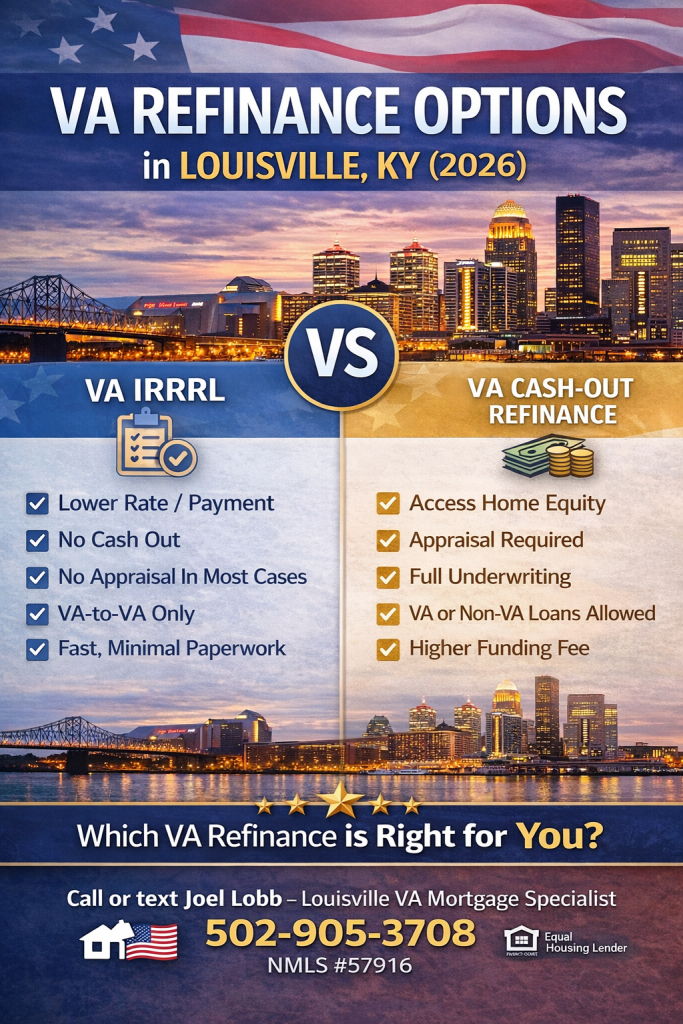
Louisville Kentucky VA Refinance for Cash out, rate and term, and IRRL streamline VA refinance Mortgage
VA Refinance in Louisville Kentucky: Complete Guide to IRRRL, Cash-Out & Rate-and-Term Options
As a Kentucky mortgage lender with over 20 years of experience, I’ve helped more than 1,300 veterans and active military members refinance their VA home loans to save money, access home equity, and achieve better loan terms. If you’re a Louisville area veteran with an existing VA mortgage, understanding your refinance options could save you thousands of dollars over the life of your loan.
This comprehensive guide covers the three main VA refinance options available to Kentucky veterans: VA Interest Rate Reduction Refinance Loans (IRRRL), cash-out refinancing, and rate-and-term refinancing.
Ready to Explore Your Refinance Options?
Get a free pre-qualification and see your refinance options today. Same-day approvals on most applications.Call or Text: 502-905-3708Email: kentuckyloan@gmail.com
What is a VA Refinance Loan?
A VA refinance loan allows veterans who already have a VA mortgage to refinance their existing home loan into new terms. Unlike traditional cash-out refinancing, VA refinancing leverages your existing VA home loan entitlement, making the process faster and more affordable.
Why refinance your VA mortgage?
Lower monthly payments through reduced interest rates
Access home equity with cash-out refinancing for home improvements, debt consolidation, or other expenses
Shorter loan terms to pay off your mortgage faster
Convert ARM to fixed-rate mortgages for payment stability
Eliminate PMI with no requirement for mortgage insurance
If you’re curious about whether refinancing makes sense for your specific situation, contact me at 502-905-3708 for a free, no-obligation consultation.
Understanding VA Loan Entitlement for Refinancing
Before exploring specific refinance programs, it’s important to understand your VA loan entitlement. Your entitlement is your “eligibility” to use the VA loan benefit.
Key entitlement facts:
The basic entitlement available to each eligible veteran is $36,000
If you’ve already used your entitlement for a previous VA purchase, you can reuse it for a refinance
A Certificate of Eligibility (COE) from the VA proves you’ve used your entitlement before
Lenders can verify entitlement status without requiring a new COE in some cases
For IRRRL refinances specifically: You only need to certify that you previously occupied the home—the occupancy requirements are different from purchase loans.
Uncertain about your entitlement status? I can help you determine your eligibility and available options at no cost. Call or text 502-905-3708 or email kentuckyloan@gmail.com.
VA IRRRL Refinance (Interest Rate Reduction Refinance Loan) – The Streamline Option
The VA Interest Rate Reduction Refinance Loan (IRRRL), also called a VA streamline refinance, is the fastest and simplest way for veterans to lower their interest rate and reduce monthly payments.
How Does a VA IRRRL Streamline Refinance Work?
The IRRRL is designed specifically to refinance an existing VA-to-VA mortgage into better terms. The VA guarantees the new loan just as it did your original mortgage, which means lenders can approve IRRRLs with minimal paperwork.
The streamline advantage:
No appraisal required
No underwriting/credit check required
No Certificate of Eligibility (COE) needed (though you can provide one)
Loan can be approved in as few as 7-10 business days
All closing costs can be rolled into the new loan amount
Minimal documentation needed
IRRRL Eligibility Requirements
To qualify for a VA IRRRL streamline refinance, you must meet these basic criteria:
You already have a VA loan – The IRRRL is only for refinancing an existing VA mortgage
VA-to-VA refinance – You’re refinancing a VA loan into another VA loan (you cannot use IRRRL to refinance into a conventional or FHA loan)
You previously occupied the home – Unlike purchase loans, you don’t need to occupy the property now; you just need to certify you did in the past
Your entitlement must be available – If you’ve used your full entitlement for another property without paying off the original loan, you may have limited options
Subordination requirement: If you have a second mortgage (home equity line of credit, second lien, etc.), the holder must agree to subordinate (place) that loan below your new VA mortgage. If they won’t, the IRRRL may not be possible.
IRRRL Closing Costs & Funding Fee
One of the biggest advantages of IRRRL refinancing is the ability to do it with “no money out of pocket” by rolling all costs into the new loan amount.
Typical IRRRL costs include:
VA funding fee (reduced for IRRRL – typically 0.55% of the loan amount)
Title insurance and title search
Recording fees and transfer taxes (varies by county)
Appraisal fee (if lender requires one, though not mandatory)
Loan origination fee
VA Funding Fee Exemptions
You do NOT pay a funding fee if you are:
A veteran receiving VA compensation for a service-connected disability
A veteran entitled to receive compensation for a service-connected disability (even if receiving military retirement pay)
A surviving spouse of a veteran who died in service or from a service-connected disability
Real-world example: On a $200,000 IRRRL refinance, a typical VA funding fee of 0.55% equals $1,100. If closing costs total $3,500, the entire amount can be rolled into your new loan, meaning zero cash at closing.
IRRRL Rate Reduction Rule – Do You Have Enough Savings?
The VA doesn’t require a minimum rate reduction for an IRRRL, but lenders do. Most lenders require a “net tangible benefit,” which typically means:
At least 0.5% rate reduction, though
1% or more is ideal to ensure meaningful monthly savings
Important warning: Some lenders promote the IRRRL as a way to reduce your loan term from 30 years to 15 years. This can dramatically increase your monthly payment, even with a lower interest rate. For example:
Current: 30-year loan at 4.5% on $200,000 = $1,013/month
Refinance: 15-year loan at 3.5% on $200,000 = $1,428/month (a $415 monthly increase!)
While you’d save interest over time, this payment increase might not be affordable. Always run the numbers carefully before pursuing a shorter loan term.
IRRRL Application Process – Timeline & Steps
Submit application – Basic loan application (NMLS Form 1003 or lender-specific form)
Verification – Lender confirms previous VA entitlement use (may contact VA directly)
Appraisal (if required) – Most lenders skip this; if needed, typically 3-5 days
Processing – Lender prepares documents and underwriting report (3-5 business days)
Approval – Clear to close, no conditions (typically days 7-10)
Closing – Sign documents and fund the loan
Funding – New loan funds and existing mortgage is paid off
Fast approval: Most IRRRLs receive approval in 7-14 days with my office.
VA Cash-Out Refinance Loans – Access Your Home Equity
A VA cash-out refinance allows you to refinance your existing VA mortgage for more than you currently owe and receive the difference in cash. This is ideal for home improvements, debt consolidation, education expenses, or other major financial needs.
How Does a VA Cash-Out Refinance Work?
When you do a cash-out refinance, your new VA loan amount includes:
The balance you owe on your existing mortgage
Plus additional funds you’re borrowing (the “cash-out” amount)
Closing costs (which can be rolled into the loan)
Example: If your home is worth $250,000 and you owe $150,000, a VA cash-out refinance could allow you to borrow up to $200,000 or more, receiving $50,000+ in cash while refinancing your original debt.
The new loan is still a VA loan with the same benefits: no down payment, no PMI, and VA guarantee protection.
VA Cash-Out Refinance Eligibility
Cash-out refinancing has slightly stricter requirements than IRRRL:
You must have a VA loan to refinance
Loan-to-Value (LTV) limits apply – Generally, lenders allow cash-out up to 80% LTV (meaning your loan can be 80% of your home’s current value)
Your home must appraise – Unlike IRRRL, appraisals are required for cash-out loans
Income verification – Full underwriting including employment verification, credit review, and income documentation
Debt-to-income ratio – Your total monthly debt (including the new mortgage) cannot typically exceed 43-50% of gross income
Home improvements – Roof repairs, additions, kitchen remodels, HVAC systems
Debt consolidation – Pay off credit cards, personal loans, or medical debt at a lower rate
Education expenses – Fund college tuition or vocational training
Emergency expenses – Major home repairs or family emergencies
Investment – Real estate investments or business opportunities
Vehicle purchase – Consolidate auto loans into one lower-rate mortgage
The math of consolidation: If you have $25,000 in credit card debt at 18% APR ($450/month), refinancing into a VA cash-out loan at 6% APR could drop your payment to $150/month while rebuilding your credit faster.
VA Cash-Out Refinance Loan Limits by County
VA doesn’t cap how much you can borrow, but lenders set limits based on:
Your VA entitlement and available entitlement
Your home’s appraised value
Your income and credit qualifications
Jefferson County (Louisville) Loan Limits: For 2026, contact me for exact loan limits in your county, as they update annually. Generally, standard VA loans have no cap on borrowing, with limits applied based on your entitlement and the property value. To maximize your borrowing without a down payment, ensure you have sufficient available entitlement.
VA Cash-Out Timeline & Process
Cash-out refinancing takes longer than IRRRL because:
Appraisal required – 7-10 days
Full underwriting – 5-10 days
Verification of employment/income – 2-5 days
Clear to close – 2-5 days
Total timeline: 21-30 days, though my office frequently closes cash-out loans in 18-21 days.
VA Rate-and-Term Refinance – Traditional Refinancing
A rate-and-term refinance is a middle ground between IRRRL and cash-out refinancing. You refinance your existing loan without borrowing additional cash, but at a better interest rate or different term.
How Does Rate-and-Term Refinancing Work?
In a rate-and-term refinance:
Your new loan amount is approximately equal to what you currently owe (plus closing costs)
You’re not taking cash out
Your loan term can change (e.g., 30 years to 20 years)
Your interest rate is refinanced at current market rates
When to use rate-and-term refinancing:
You need a better rate than IRRRL allows
You’re converting an ARM (adjustable-rate) to a fixed-rate mortgage
You want to shorten your loan term without taking cash out
You prefer not to go through full cash-out underwriting
Rate-and-Term Eligibility
Rate-and-term refinancing sits between IRRRL and cash-out in terms of underwriting:
Some lenders require simplified underwriting (not full)
Appraisals may or may not be required
Income verification typically required
Credit check is standard
Debt-to-income limits apply (usually 43-50%)
When to Choose Rate-and-Term vs. IRRRL
Factor
IRRRL
Rate-and-Term
Rate reduction required
Usually 0.5%+
Can refinance at higher rate if needed
Underwriting
Minimal – streamlined
Moderate – some verification
Timeline
7-14 days
15-25 days
Closing costs
~$2,500-3,500
~$3,500-5,000
Best for
Faster, easier refis
More flexibility, specific goals
ARM to fixed
Yes
Yes
Comparison: IRRRL vs. Cash-Out vs. Rate-and-Term
Feature
IRRRL
Cash-Out
Rate-and-Term
No appraisal
✓
✗ (required)
~ (varies)
No underwriting
✓
✗ (full)
~ (simplified)
Access cash
✗
✓
✗
Fastest approval
✓ (7-10 days)
✗ (21-30 days)
~ (15-25 days)
Best rate
✓ (usually)
~
~
Flexibility
Limited
High
Moderate
Funding fee
0.55%
0.55%+
0.55%+
Occupancy requirement
Previous only
Current property
Current property
VA Funding Fees Explained – What You’ll Pay
All VA refinances include a funding fee (unless you’re exempt due to service-connected disability):
2026 VA Funding Fee Rates for Refinancing
For IRRRL (streamline) refinances:
First-time refinancers, no down payment: 0.55% of loan amount
Subsequent refinancers, no down payment: 0.55% (same as IRRRL)
National Guard/Reserve: Slightly higher (about 0.575%)
For cash-out and rate-and-term refinances:
First-time, no down payment: 2.3% of loan amount
Subsequent users, no down payment: 3.6% of loan amount
National Guard/Reserve: Higher percentages apply
Funding Fee Example: • $200,000 IRRRL with 0.55% fee = $1,100 • $200,000 cash-out with 2.3% fee = $4,600
The good news? You can finance the funding fee into your new loan, so you don’t need to pay cash at closing.
Funding Fee Exemptions – You Might Not Pay
You’re exempt from the VA funding fee if you:
Receive VA disability compensation for a service-connected disability (any percentage)
Are entitled to receive compensation for service-connected disability but receive military retirement/active duty pay instead
Are a surviving spouse of a veteran who died in service or from service-connected disability
If you’re exempt, provide VA documentation (VA letter of eligibility, DD Form 214, or similar) to your lender.
VA Loan Entitlement & Limits for Louisville, Kentucky
Your VA entitlement determines how much you can borrow without a down payment. The basic entitlement is $36,000, but if you have significant available entitlement, you can borrow much more.
How Entitlement Works
Example: • Basic entitlement: $36,000 • If your home value is $250,000 and you’re fully qualified: • You can borrow up to 4x your available entitlement without a down payment • $36,000 × 4 = $144,000 maximum • So lenders would typically fund up to $144,000 without requiring a down payment
However, if you have a higher purchase price or the property appraises for more, you may need to put money down.
For refinancing: Your available entitlement is what matters. If you have restored entitlement (paid off a previous VA loan), you have more borrowing capacity.
Jefferson County, Kentucky Loan Limits (2026)
Contact me for exact loan limits in your county, as they update annually. Generally:
Standard VA loans: No cap on borrowing
Loan limits apply based on your entitlement and income qualification
To maximize your borrowing without a down payment, ensure you have sufficient available entitlement
Common VA Refinance Questions Answered
Do I Need a Certificate of Eligibility for an IRRRL?
No, a new Certificate of Eligibility (COE) is not required for IRRRL refinances. Your lender can verify entitlement through the VA’s online system. However, if you have your COE handy, you can provide it to speed up verification.
Can I Refinance an ARM (Adjustable-Rate Mortgage) with VA?
Yes! Converting an ARM to a fixed-rate VA mortgage is a common and smart use of IRRRL or rate-and-term refinancing. When interest rates are low, this can lock in predictable payments for 30 years.
How Much Will My Monthly Payment Drop?
The payment reduction depends on:
Interest rate reduction – Each 1% lower rate saves roughly $215/month per $100,000 borrowed
Loan term – Shorter terms = higher payments but less total interest
Loan amount – Larger loans have proportionally larger payment changes
Quick calculation: Refinancing $150,000 from 5% to 4% typically saves ~$165/month.
Can I Refinance if I Have Bad Credit?
Yes, VA refinancing is more flexible than conventional financing:
IRRRL: No credit check required
Cash-out/Rate-and-term: Minimum credit score typically 580-620
Even with recent delinquencies, many veterans qualify
If you have credit concerns, discuss them with me. I’ve helped veterans with bankruptcies, foreclosures, and late payments refinance successfully.
How Long Does Refinancing Take?
IRRRL: 7-14 days (fastest)
Rate-and-term: 15-25 days
Cash-out: 21-30 days
My office often beats these timelines with efficient processing.
What Happens to My Current Mortgage During Refinancing?
Your old mortgage remains active until the new loan funds and pays it off. Once the new loan closes:
The new lender sends funds to the old lender
Old mortgage is paid off in full
Your home title is transferred to the new lender
You begin payments on the new mortgage
There’s no gap in coverage or risk of losing your home.
VA Refinance Success Stories from Louisville Veterans
Over 20+ years, I’ve helped thousands of Kentucky veterans refinance. Here are real-world examples:
Example 1 – IRRRL Streamline Savings
Jim’s Story: Jim, a Louisville veteran, had a VA mortgage at 5.5% on $180,000. When rates dropped to 4.25%, he did an IRRRL refinance in just 10 days. His monthly payment dropped from $1,022 to $886—saving him $136/month or $1,632/year. No appraisal, no underwriting. Clean and simple.
Example 2 – Cash-Out for Home Improvement
Maria’s Story: Maria, a Fort Knox-area veteran, had $280,000 owed on her home valued at $380,000. She refinanced with a $300,000 VA cash-out loan, receiving $20,000 to renovate her kitchen and update the home’s electrical system. Her payment only increased $150/month while adding home value and equity.
Example 3 – ARM to Fixed-Rate Security
David’s Story: David’s VA ARM mortgage was set to adjust upward from 3.8% to 5.2%. Before the adjustment, he refinanced into a 30-year fixed VA loan at 4.3%, locking in stability. His payment actually decreased while eliminating the risk of rising rates.
Why Work With Me for Your VA Refinance?
I’m Joel Lobb, NMLS #57916, and I’ve spent 20+ years specializing in Kentucky VA mortgages. Here’s what sets my service apart:
✓ Local expertise – I know Louisville, Jefferson County, Fort Knox, and all 120 Kentucky counties
✓ Fast approvals – Same-day pre-approval on most applications; average close in 18-21 days
✓ Transparent guidance – I explain all options without pressure and help you choose what’s best for YOUR situation
✓ Personal service – I answer my phone and attend most closings personally
✓ 1,300+ families helped – Over two decades of proven success
✓ Free pre-qualification – No hidden fees, no commitment
✓ 24/7 accessibility – Call or text me anytime
Your Next Steps
Ready to explore your refinance options?
Call or text me at 502-905-3708 – I’ll discuss your current mortgage and goals
Send your information to kentuckyloan@gmail.com – I’ll analyze your situation and options
Complete a free pre-qualification – Same-day approvals on most applications
Lock in your rate – Secure the best rate available
No pressure. No obligation. Just honest guidance from a Kentucky veteran mortgage expert.
Ready to Start Your VA Refinance?
Get a free pre-qualification today and discover how much you could save with VA refinancing.📞 Call or Text: 502-905-3708📧 Email: kentuckyloan@gmail.com🌐 Visit: http://www.kentuckyvamortgage.com
Important Disclaimers
This website and content are not endorsed by the VA, FHA, USDA, or any government agency. They are provided for educational purposes only.
Loan qualification: All loans are subject to:
Income verification and credit approval
Property appraisal and valuation (when required)
Sufficient equity (LTV requirements)
Debt-to-income ratio limits
Final underwriting approval
Rate changes: Interest rates are subject to market conditions and change daily. Rates mentioned are examples only.
Equal Housing Opportunity: I am an Equal Housing Lender. I serve all applicants fairly regardless of race, color, national origin, religion, sex, familial status, or disability.
No statement on this site is a commitment to make a loan. Loans are subject to borrower qualifications, including income, property evaluation, sufficient equity in the home to meet Loan-to-Value requirements, and final credit approval. Approvals are subject to underwriting guidelines, interest rates, and program guidelines and are subject to change without notice based on applicant’s eligibility and market conditions. Refinancing an existing loan may result in total finance charges being higher over the life of a loan. Reduction in payments may reflect a longer loan term. Terms of any loan may be subject to payment of points and fees by the applicant. Equal Opportunity Lender.

 KENTUCKY VA MORTGAGE LENDER
You must be logged in to post a comment.