I have successfully originated over 200 VA Home loans in Kentucky. Put my experience to work for you. Call or text me today at 502-905-3708 or email me at Kentuckyloan@gmail.com-This website is not affiliated with the VA or any other government agency. NMLS #57916 Equal Housing Lender. Same Day Approvals, Fast Closings, and a Local Veteran offering VA Home Loans in Kentucky. Free Credit Report and Pre-Approvals NMLS# 57916 Joel Lobb Loan Originator, Company NMLS ID 1738461 . Equal Housing Lender
For all student loans, whether deferred, in forbearance, or in repayment (not deferred), the lender must use the greater of the following to determine the monthly payment to be used as the borrower’s recurring monthly debt obligation:
1% of the outstanding balance; or
The actual documented payment (documented in the credit report, in documentation obtained from the student loan lender, or in documentation supplied by the borrower).
If the payment currently being made cannot be documented or verified, 1% of the outstanding balance must be used.
Exception: If the actual documented payment is less than 1% of the outstanding balance and it will fully amortize the loan with no payment adjustments, the lender may use the lower, fully-amortizing monthly payment to qualify the borrower.
FHLMC
Use the following:
The payment on the credit report
.5% of the outstanding balance or
The actual documented fully amortizing payment.
FHA
Student loans:
Regardless of the payment status, the mortgagee must use:
The GREATER of:
.5% of the outstanding balance on the loan; or
The monthly payment reported on the credit report; or
The actual documented payment, provided the payment will fully amortize the loan over its term.
For example:
Student loan reporting on credit with a balance of $15,000 and a payment of $55.00. 1% of the balance is greater than the payment reporting, so you would use 1%.
If there is documentation showing a fully amortized payment of $125.00, you could use that payment instead of the 1%.
VA
May be excluded from the borrower’s total monthly obligations with evidence of a minimum of 12 months deferment from date of closing.
If there is no monthly payment reflected on the credit report, a copy of the borrower’s payment letter or promissory note should be used to determine what payment amount to use.
USDA
Fixed payment loans: A fixed payment may be used in the debt ratio when the lender retains documentation to verify the payment is fixed, the interest rate is fixed, and the repayment term is fixed. There must be no future adjustments to the terms of the student loan payments.
Non-Fixed payment loans: Payments for deferred loans, Income Based Repayment (IBR), Graduated, Adjustable, and other types of repayment agreements which are not fixed cannot be used in the total debt ratio calculation. One percent of the loan balance reflected on the credit report must be used as the monthly payment. No additional documentation is required.
Kentucky VA Mortgage Lender
Tips from VA for Ordering a Certificate of Eligibility (COE) for a Kentucky Mortgage VA loan Pre-approval
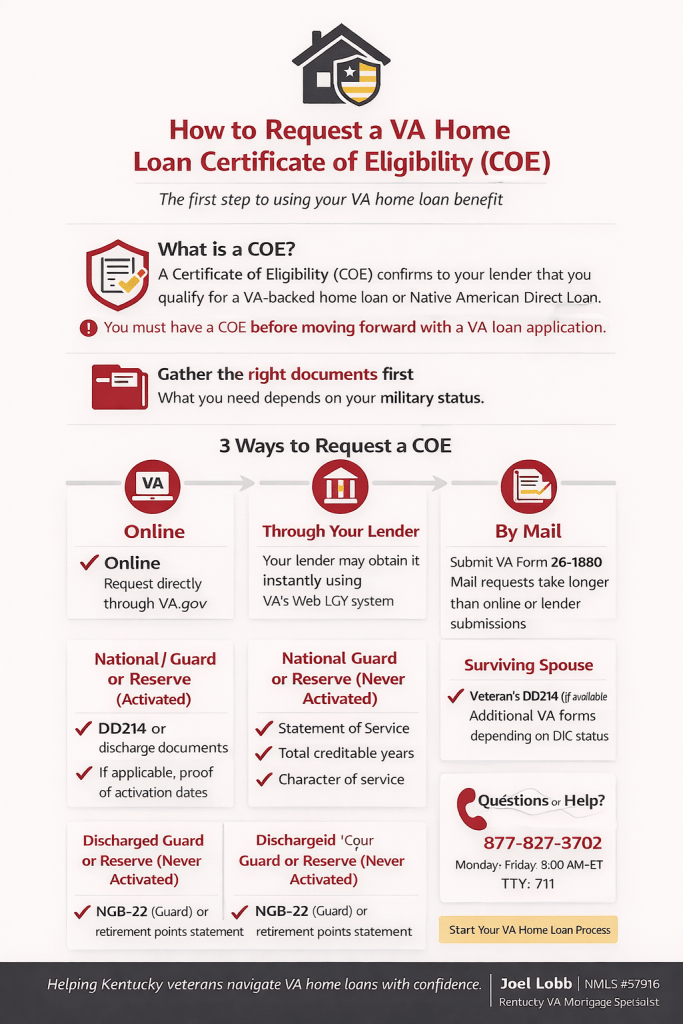
How to Request a VA Home Loan COE
How to Request a VA Home Loan Certificate of Eligibility (COE)
A Certificate of Eligibility (COE) is the first step in getting a VA-backed home loan or Native American Direct Loan.
The COE confirms to your lender that you qualify for the VA home loan benefit and are eligible to move forward with a VA mortgage.
Once your COE is issued, you can choose a loan type and continue through the rest of the VA loan application process.
How to Prepare Before You Request a COE
Before starting your COE request, gather the documents you’ll need.
The required paperwork depends on your military service status.
Veteran
Copy of your discharge or separation papers (DD214)
Active-Duty Service Member
You’ll need a Statement of Service signed by your commander, adjutant, or personnel officer.
The statement must include:
Your full name
Your Social Security number
Your date of birth
The date you entered active duty
The duration of any lost time
The name of the command providing the information
Current or Former Activated National Guard Member
Copy of your DD214 or other discharge documents
If applicable, proof of activation dates, such as:
DD214 showing qualifying 32 USC activation sections
An annual retirement points statement
DD220 with accompanying orders
Current or Former Activated Reserve Member
Copy of your DD214 or other discharge documents
Current National Guard or Reserve Member Who Has Never Been Activated
You’ll need a Statement of Service signed by your commander, adjutant, or personnel officer showing:
Your full name
Your Social Security number
Your date of birth
The date you entered duty
Your total number of creditable years of service
The duration of any lost time
The name of the command providing the information
Discharged National Guard Member Who Was Never Activated
Report of Separation and Record of Service (NGB Form 22) for each period of service
Retirement Points Statement (NGB Form 23) and proof of character of service
Discharged Reserve Member Who Was Never Activated
Copy of your latest annual retirement points statement
Proof of honorable service
Surviving Spouse
If you qualify as a surviving spouse, you’ll typically need the Veteran’s DD214 (if available).
Additional VA forms may be required depending on whether you receive Dependency and Indemnity Compensation (DIC).
How to Request a COE
You can request a Certificate of Eligibility in one of three ways.
Option 1: Online
Request your COE directly through VA.gov. This is often the fastest option.
Option 2: Through Your Lender
Your lender may be able to obtain your COE instantly using the VA’s Web LGY system.
Ask your lender if they can request the COE on your behalf.
Option 3: By Mail
Complete VA Form 26-1880 (Request for a Certificate of Eligibility) and mail it to the address
listed on the last page of the form. Mail requests typically take longer than online or lender submissions.
What Happens After You Request a COE?
The VA reviews your request and issues a decision
You can check the status of your COE request online
Next Steps After Your COE Is Issued
Requesting a COE is only part of the VA loan process. After your COE is issued:
Your lender orders a VA appraisal to assess market value
Your lender reviews your income, credit, and documentation
If approved, a title company is selected and closing is scheduled
Questions About the VA Loan Process?
If you have questions your lender can’t answer, you can contact a VA home loan representative at
877-827-3702 (TTY: 711), Monday through Friday, 8:00 a.m. to 6:00 p.m. ET.
Kentucky VA Loan Assistance
If you’re buying a home in Kentucky, I can help you determine which documents apply to your service history
and coordinate with your lender to request the COE when eligible.
Text or call: 502-905-3708
Joel Lobb – NMLS #57916
Informational only. Not affiliated with or acting on behalf of the U.S. Department of Veterans Affairs.
Not a commitment to lend. Subject to credit approval and program guidelines. Kentucky only.
How to request a VA home loan Certificate of Eligibility (COE)
Learn how to request a VA home loan Certificate of Eligibility (COE). This is the first step in getting a VA-backed home loan or Native American Direct Loan. It confirms for your lender that you qualify for the VA home loan benefit.
1
How do I prepare before I start a COE request?
Select the description here that matches you best to find out what you’ll need.
You’ll need a copy of your discharge or separation papers (DD214).
You’ll need a statement of service—signed by your commander, adjutant, or personnel officer—showing:
Full name & Social Security number
Date of birth & Date you entered duty
Duration of any lost time
Name of the command providing the information
You’ll need a copy of your DD214 or other discharge documents.
Note: If you have 90+ days of active service (with 30 consecutive), provide a document showing activation date (DD214, annual point statement, or DD220 with orders).
You’ll need the Veteran’s discharge documents (DD214) if available.
If receiving DIC:
Submit VA Form 26-1817 (Request for Determination of Loan Guaranty Eligibility).
If NOT receiving DIC:
Submit VA Form 21P-534EZ, Marriage License, and Veteran’s Death Certificate.
2
How do I request a COE?
💻
Online
The fastest way to apply through the VA.gov portal.
🏦
Via Lender
Most lenders can access “Web LGY” to get it for you instantly.
✉️
By Mail
Fill out VA Form 26-1880 and mail to your regional center.
What happens next?
The VA will review your request and notify you of the decision. Once you have your COE, the lending process typically follows these steps:
✓
VA Appraisal
The lender requests an assessment to estimate the house’s market value.
✓
Review & Underwriting
Lenders review your credit, income, and the appraisal report.
✓
Closing
Ownership is transferred at a title company or similar entity.
function toggleAccordion(button) {
const item = button.parentElement;
const isActive = item.classList.contains(‘active’);
// Close all items
document.querySelectorAll(‘.accordion-item’).forEach(el => {
el.classList.remove(‘active’);
});
// Open clicked item if it wasn’t active
if (!isActive) {
item.classList.add(‘active’);
}
}
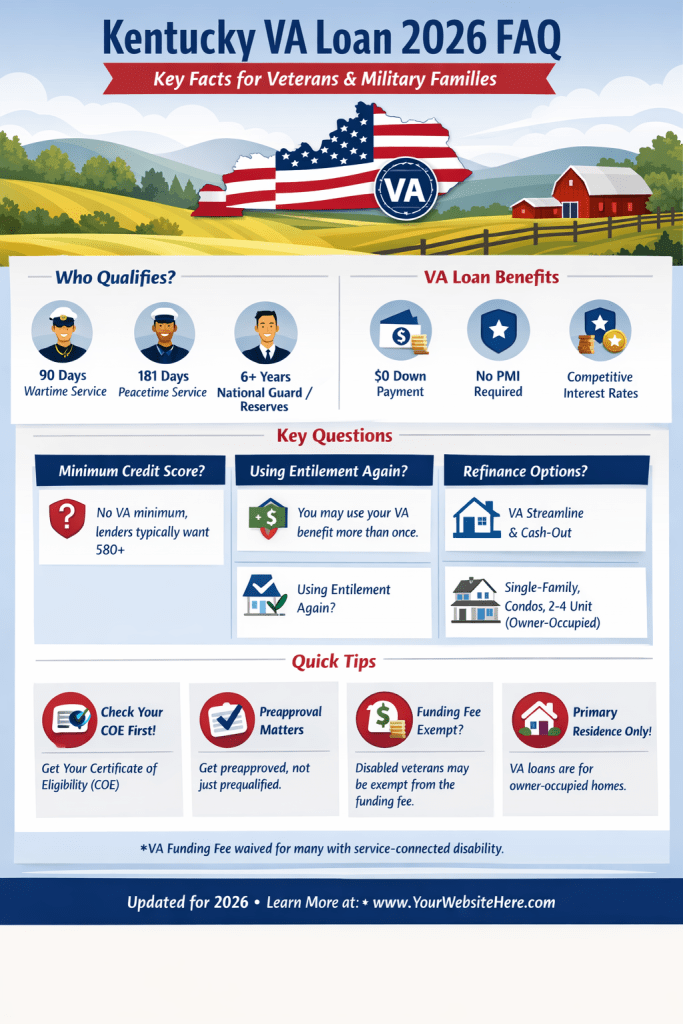
Most Asked Questions About Kentucky VA Loans (2026 FAQ)
If you’re a veteran, active duty service member, or surviving spouse in Kentucky, the VA loan can be one of the strongest paths to homeownership.
This 2026 FAQ answers the questions buyers ask the most—eligibility, credit, income, entitlement, funding fee, rates, assumptions, and refinancing.
Quick Take (tell-it-like-it-is)
Eligibility means you earned the benefit. Approval means you meet lender underwriting.
VA doesn’t set a minimum credit score, but lenders often do.
VA loans are for primary residences—no rentals or vacation homes.
Funding fee applies unless you’re exempt (often due to service-connected disability).
VA loan entitlement is the portion of your VA benefit that backs (guarantees) a percentage of your mortgage for an approved lender.
The VA does not issue home loans directly—lenders do—while the Department of Veterans Affairs provides the guaranty that makes $0 down and no PMI possible.
In 2026, veterans with full entitlement are not subject to county loan limits for a primary residence, but you still must qualify based on income, credit, and the home’s appraised value.
Am I eligible as a surviving spouse?
Many surviving spouses are eligible for VA home loan benefits. Common eligibility paths include:
Unmarried surviving spouse of a veteran who died on active duty or from a service-connected disability
Surviving spouses who remarried after age 57 and on/after December 16, 2003 may remain eligible
Spouse of an active-duty service member who is MIA or POW for 90+ days may be eligible for one-time use
Surviving spouses may also be eligible for VA refinancing options in some circumstances, including VA Streamline (IRRRL).
How do I get my Certificate of Eligibility (COE)?
The COE is the official proof of your eligibility and entitlement. Most lenders can retrieve it electronically in minutes.
Veterans can also request the COE through the VA, which may take longer. Bottom line: you can’t close a VA loan without a COE.
Who is eligible for a VA loan?
You may be eligible if any one of the following is true:
90 days of active duty during wartime
181 days of active duty during peacetime
6 years in the National Guard or Reserves
Eligible surviving spouse
Eligibility vs. prequalification vs. preapproval
Eligibility confirms you earned the VA benefit. Prequalification is an initial estimate of buying power. Preapproval is the stronger, document-backed step
that real estate agents and sellers take seriously. If you’re shopping in Kentucky, aim for preapproval—not just a quick prequal—before making offers.
Entitlement & Using Your VA Loan More Than Once
How does entitlement work in 2026?
Entitlement generally has two layers (basic and bonus) that together determine the VA guaranty.
If you’ve used your VA loan before, you may still have remaining entitlement available. Prior use does not automatically block another VA purchase—structure matters.
How do I restore my VA entitlement?
Full entitlement is commonly restored when you sell the home and the VA loan is paid off. You then request restoration through the VA (typically with VA Form 26-1880),
along with documentation showing payoff. In limited cases, a one-time restoration may apply.
What is “second-tier” entitlement?
Second-tier entitlement can help veterans buy again after prior VA loan usage or even a foreclosure history.
Depending on remaining entitlement and purchase price, a down payment may be needed. This is where a lender who understands VA structure makes a difference.
Can I use a VA loan for a second home or rental property?
No. VA loans are designed for owner-occupied primary residences. You must intend to occupy the home as your primary residence within a reasonable time after closing.
Qualification: Credit, Income, DTI & Residual Income
Who sets VA loan guidelines: the VA or my lender?
The VA sets minimum standards. Lenders add overlays. VA does not publish a minimum credit score, but most lenders use a benchmark.
You must satisfy both VA requirements and the lender’s underwriting rules to get approved.
If I have bad credit, can I still get a VA loan?
Possibly. Here’s the straight answer: poor credit can be worked around in some cases, but it depends on the overall risk profile—income stability, residual income, payment history,
and how recent the credit events are. “Quick fixes” usually fail; documented improvement and a clean recent history work.
Can someone else sign on the loan with me?
VA co-borrowers are restricted. In most cases, the co-borrower must be your spouse or another eligible veteran.
Parents, friends, or significant others who are not eligible veterans typically cannot co-borrow on a VA loan.
What income can I use to qualify?
Lenders verify that you have stable, reliable income and enough residual income after housing and debts. Common income sources include:
Military base pay and allowances (including BAH, when stable and likely to continue)
Non-military employment
Retirement and disability income
Self-employment (with additional documentation)
Commissions, overtime, bonus income (typically needs a 2-year history)
Spouse’s income, alimony/child support (when documentable and expected to continue)
How long after bankruptcy or foreclosure can I qualify?
Bankruptcy and foreclosure do not automatically disqualify you, but timing matters. Many lenders look for about 2 years after Chapter 7 discharge or foreclosure.
Chapter 13 may be possible after 12 months of on-time plan payments with trustee approval, depending on the lender. Overlays apply—this is not one-size-fits-all.
Do I need tax returns to apply?
Not always. Many borrowers can qualify without providing tax returns, because lenders can use IRS transcripts and W-2/paystub documentation.
Self-employed or commission-heavy income usually requires tax returns and additional paperwork.
Rates, Closing Costs & the VA Funding Fee (2026)
What fees should I expect to pay?
VA limits certain charges to protect veterans from excessive lender fees. Typical costs include title/settlement fees, appraisal, credit report,
and the VA funding fee (unless you’re exempt). Sellers can contribute up to a set amount in concessions, which may help reduce your cash to close.
What is the VA funding fee?
The VA funding fee is a one-time fee that helps keep the VA loan program running and replaces monthly mortgage insurance.
The fee varies based on loan type (purchase/refi), down payment (if any), and whether it’s first-time or subsequent use.
Many veterans with service-connected disability ratings are exempt from the funding fee.
If you want, we can estimate your funding fee based on your COE status and the exact structure of the loan.
How are VA loan rates determined?
Rates are driven by broader markets (especially bonds) and by your risk profile (credit, down payment, occupancy, property type).
Rate pricing can change daily. If you’re shopping seriously, timing your lock strategy matters.
Does my credit score affect my VA loan rate?
Yes. Even with VA’s flexibility, stronger credit typically improves pricing and reduces lender conditions.
If your scores are borderline, improving them before you lock can materially reduce the total cost over time.
Does the VA loan offer adjustable rates?
Some lenders offer VA ARMs (adjustable-rate mortgages). They can make sense for short-term ownership plans (common with relocations),
but they are not the default best option for most buyers.
VA Loan Guidelines & Common Rules
Can I borrow more than the home’s value?
On purchases, VA financing is tied to the appraised value and allowable costs. Cash-back is limited on purchases.
For refinances, VA Cash-Out can allow high loan-to-value in certain scenarios, subject to lender guidelines.
Can I have more than one VA loan at a time?
Sometimes, yes—typically tied to legitimate occupancy needs (relocation, deployments, job moves).
Most veterans have one VA loan at a time, but multiple VA loans can be possible depending on remaining entitlement and circumstances.
What is the maximum VA home loan?
VA does not set a maximum loan amount for borrowers with full entitlement. Your maximum is determined by income qualification,
residual income, credit, and the property’s appraised value.
Are VA loans assumable?
Yes. VA loans are assumable, which means a qualified buyer may be able to take over the existing rate and terms.
Assumability can be a major resale advantage in higher-rate environments, but the buyer must qualify and the servicer must approve the assumption.
Can I pay off a VA loan early?
Yes. VA loans do not have a prepayment penalty. You can pay extra principal or pay off the loan early without lender penalties.
When is a VA loan NOT the best option?
VA is the strongest fit for most eligible buyers—especially those using $0 down. That said, if you have a large down payment and exceptional credit,
conventional financing can sometimes compete on pricing. The best move is a side-by-side comparison, not an assumption.
VA Refinancing (2026)
Can the VA loan help lower my monthly bills?
VA has two primary refinance options:
VA IRRRL (Streamline): Designed to reduce rate/payment on an existing VA loan with lighter documentation.
VA Cash-Out Refinance: Refinance and potentially access equity; can also refinance a non-VA loan into VA if eligible.
Streamlines can sometimes be completed without an appraisal, depending on lender policy.
Can I refinance into a VA loan if I don’t currently have one?
Yes. Eligible veterans can refinance a conventional or FHA mortgage into a VA loan using the VA Cash-Out refinance program
(even if you’re not taking cash out), subject to underwriting and lender guidelines.
What Types of Homes Can I Buy With a VA Loan?
You can typically use a VA loan in Kentucky to:
Buy a primary residence (single-family home)
Buy a VA-approved condo
Buy up to a 4-unit property (one unit must be owner-occupied)
Build a home (with additional requirements)
Buy and improve a home in certain scenarios
You cannot use a VA loan to buy a vacation home or an investment property you won’t occupy as your primary residence.

 KENTUCKY VA MORTGAGE LENDER
You must be logged in to post a comment.