
Kentucky VA Farm Loan Guidelines

Kentucky VA Farm Loan Guidelines


Farm Loans: Kentucky VA Home Loans Overview

Kentucky VA Home Loans

Can You Buy a Farm in Kentucky With a VA Home Loan?

Yes, in many cases. The VA Home Loan benefit can be used to purchase a farm property in Kentucky when there is a residence on the land and the Veteran will live in that home as a primary residence. VA loans are for residential purposes and cannot be used to buy a business.

Kentucky eligibility rules for “farm” properties

  • There must be a residential dwelling on the land.
  • The Veteran must occupy the home as their primary residence.
  • The loan must be primarily for a residence, not for purchasing a business or commercial operation.
  • Properties that are primarily commercial farms (business-first) may not qualify.

Practical Kentucky example: A home on acreage in areas like Oldham County, Shelby County, Spencer County, Hardin County, or rural Warren County can be workable when comps support residential use and the home is the primary purpose of the purchase.

Appraisal, acreage, and outbuildings in Kentucky

  • VA does not set a maximum number of acres.
  • Acreage typically isn’t an issue if comparable sales in the area sold primarily for residential use.
  • Outbuildings and improvements like barns, sheds, corrals, stables, and pastures may be considered in value as residential-related improvements.
  • The VA valuation must not include livestock, crops, or farm equipment/supplies.

This is why “comps” matter in Kentucky: if the closest comparable sales are residential-with-acreage (not commercial ag sales), underwriting is usually more straightforward. :contentReference[oaicite:1]{index=1}

Using farm income to qualify

If some or all of the income needed to qualify comes from farming operations, the VA requires verification that the Veteran has the ability and experience to operate the farm. :contentReference[oaicite:2]{index=2}

  • Expect documentation similar to self-employment (history, consistency, and ability to continue).
  • We’ll focus on stable, documentable qualifying income—not one-time or speculative income.

VA vs FHA vs USDA acreage comparisons (Kentucky)

The real-world issue usually isn’t a hard acreage cap. It’s whether the property is primarily residential, whether comps support the value, and whether there are income-producing features that make the property look like a business purchase.

Program Does it have a strict acreage limit? What underwriters/appraisers care about Common Kentucky “deal killers”
VA No stated acre limit. Primary residence requirement, residential comps, no value for livestock/crops/equipment; residential-only valuation for farmland portion. Property is primarily a working commercial farm; comps are commercial ag sales; value tied to business assets. :contentReference[oaicite:3]{index=3}
FHA No universal acre cap; must be typical for the area and primarily residential. Residential highest-and-best use, marketability, and appraisal support; avoid properties that function like a commercial operation. Commercial ag use dominates; unique specialty improvements without residential market support.
USDA (Guaranteed) No specific site size/acreage limit, but it must be predominantly residential. Predominantly residential character; the property must not include buildings principally used for income-producing purposes. Income-producing land or facilities used primarily for ag/commercial enterprise; property fails rural eligibility mapping. :contentReference[oaicite:4]{index=4}
Quick Kentucky rule of thumb
Residential-first Comps must fit No business purchase Documentable income Clear occupancy plan

Steps to a VA home loan (including farm properties)

  1. Get your Certificate of Eligibility (COE). Lenders can typically retrieve this electronically.
  2. Get preapproved with a VA-experienced lender and connect with a Realtor.
  3. Choose a home and sign a purchase agreement that includes a VA financing contingency.
  4. Order the VA appraisal and clear final underwriting conditions for closing.

If you’re looking at acreage properties in Kentucky, send the listing early. The earlier we evaluate comps and “residential vs business” risk, the fewer surprises you’ll have later.

FAQ: Kentucky VA farm properties

Can a VA loan be used on a property with barns and stables?

Often, yes, if the property is primarily residential and the improvements contribute to residential market value. The VA valuation cannot include livestock, crops, or farm equipment. :contentReference[oaicite:5]{index=5}

Does VA cap acreage?

No stated acreage limit. The focus is on residential use and comparable sales support. :contentReference[oaicite:6]{index=6}

Can I use farm income to qualify?

Potentially, yes. VA requires documentation and verification of ability/experience as a farm operator when farming income is used to qualify. :contentReference[oaicite:7]{index=7}

What makes a farm property ineligible?

When it’s primarily a business purchase (commercial farm), or value depends on business assets like livestock, crops, or equipment.


.inf-wrap{border-radius:16px;padding:16px;background:#fff;border:1px solid rgba(0,0,0,.12)} .inf-top{display:flex;flex-direction:column;gap:6px;margin-bottom:10px} .inf-title{font-size:22px;line-height:1.2;margin:0} .inf-sub{margin:0;opacity:.9} .inf-grid{display:grid;grid-template-columns:1fr;gap:10px;margin-top:12px} @media(min-width:820px){.inf-grid{grid-template-columns:1fr 1fr}} .inf-card{border:1px solid rgba(0,0,0,.12);border-radius:14px;padding:12px;background:rgba(0,0,0,.02)} .inf-h{font-size:16px;margin:0 0 6px} .inf-ul{margin:6px 0 0 18px} .inf-footer{margin-top:12px;font-size:14px;opacity:.92} .inf-badge{display:inline-block;margin-top:6px;padding:6px 10px;border-radius:999px;border:1px solid rgba(0,0,0,.14);background:#fff;font-size:13px}

One-page guide

VA Farm Property Eligibility (Kentucky)

Use this checklist before writing an offer on acreage property.

Primary residence required Residential purpose only Acreage not capped
Must-haves
  • Home on the land
  • Veteran occupies as primary residence
  • Property is primarily residential
  • Comparable sales support residential-with-acreage value
What cannot be included in value
  • Livestock
  • Crops
  • Farm equipment or supplies
Often OK (when residential)
  • Barns, sheds, corrals, stables
  • Pastures and typical rural improvements
  • Farm income, if documentable and experience is verified
Common red flags
  • Commercial farm operation is the main purpose
  • Value relies on business assets
  • No good residential comps (only ag/commercial sales)
{ “@context”:”https://schema.org”, “@type”:”BreadcrumbList”, “itemListElement”:[ {“@type”:”ListItem”,”position”:1,”name”:”Home”,”item”:”https://www.mylouisvillekentuckymortgage.com/”}, {“@type”:”ListItem”,”position”:2,”name”:”VA Loans”,”item”:”https://www.mylouisvillekentuckymortgage.com/p/va-loans.html”}, {“@type”:”ListItem”,”position”:3,”name”:”VA Farm Properties in Kentucky”,”item”:”https://www.mylouisvillekentuckymortgage.com/p/va-farm-loan-kentucky.html”} ] } { “@context”:”https://schema.org”, “@type”:”FAQPage”, “mainEntity”:[ { “@type”:”Question”, “name”:”Can a VA loan be used to buy a farm property in Kentucky?”, “acceptedAnswer”:{“@type”:”Answer”,”text”:”Often yes, when there is a residence on the land and the Veteran will occupy it as a primary residence. VA loans are for residential purposes and cannot be used to purchase a business.”} }, { “@type”:”Question”, “name”:”Does the VA limit the number of acres?”, “acceptedAnswer”:{“@type”:”Answer”,”text”:”No stated acreage cap. The appraisal and underwriting focus on whether the property is primarily residential and whether comparable sales support the value.”} }, { “@type”:”Question”, “name”:”Can barns, stables, and sheds be included?”, “acceptedAnswer”:{“@type”:”Answer”,”text”:”They may contribute to value when they support residential market value. VA valuation cannot include livestock, crops, or farm equipment/supplies.”} }, { “@type”:”Question”, “name”:”Can farm income be used to qualify?”, “acceptedAnswer”:{“@type”:”Answer”,”text”:”Potentially, yes. When farm income is used, VA requires verification of the Veteran’s ability and experience as a farm operator and documentation similar to self-employment income.”} } ] } { “@context”:”https://schema.org”, “@type”:”MortgageBroker”, “name”:”Joel Lobb, Mortgage Broker FHA, VA, KHC, USDA”, “identifier”:”NMLS 57916″, “areaServed”:{“@type”:”State”,”name”:”Kentucky”}, “serviceType”:[ “VA Home Loans”, “FHA Home Loans”, “USDA Rural Housing Loans”, “Kentucky First-Time Homebuyer Mortgage Guidance” ] }

STUDENT LOAN CLARIFICATION FOR ALL LOAN PROGRAMS


STUDENT LOAN CLARIFICATION FOR ALL LOAN PROGRAMS
PROGRAM
GUIDELINE
FNMA
For all student loans, whether deferred, in forbearance, or in repayment (not deferred), the lender must use the greater of the following to determine the monthly payment to be used as the borrower’s recurring monthly debt obligation:
  • 1% of the outstanding balance; or
  • The actual documented payment (documented in the credit report, in documentation obtained from the student loan lender, or in documentation supplied by the borrower).
If the payment currently being made cannot be documented or verified, 1% of the outstanding balance must be used.
Exception: If the actual documented payment is less than 1% of the outstanding balance and it will fully amortize the loan with no payment adjustments, the lender may use the lower, fully-amortizing monthly payment to qualify the borrower.
FHLMC
Use the following:
  • The payment on the credit report
  • .5% of the outstanding balance or
  • The actual documented fully amortizing payment.
FHA
Student loans:
Regardless of the payment status, the mortgagee must use:
  • The GREATER of:
    • .5% of the outstanding balance on the loan; or
    • The monthly payment reported on the credit report; or
  • The actual documented payment, provided the payment will fully amortize the loan over its term.
For example:
Student loan reporting on credit with a balance of $15,000 and a payment of $55.00. 1% of the balance is greater than the payment reporting, so you would use 1%.
If there is documentation showing a fully amortized payment of $125.00, you could use that payment instead of the 1%.
VA
May be excluded from the borrower’s total monthly obligations with evidence of a minimum of 12 months deferment from date of closing.
 
If there is no monthly payment reflected on the credit report, a copy of the borrower’s payment letter or promissory note should be used to determine what payment amount to use.
USDA
Fixed payment loans:  A fixed payment may be used in the debt ratio when the lender retains documentation to verify the payment is fixed, the interest rate is fixed, and the repayment term is fixed.  There must be no future adjustments to the terms of the student loan payments.
Non-Fixed payment loans:  Payments for deferred loans, Income Based Repayment (IBR), Graduated, Adjustable, and other types of repayment agreements which are not fixed cannot be used in the total debt ratio calculation.  One percent of the loan balance reflected on the credit report must be used as the monthly payment.  No additional documentation is required.

How to Get Your VA Certificate of Eligibility for a VA Home Loan Approval.

Kentucky VA Mortgage Lender
Tips from VA for Ordering a Certificate of Eligibility (COE) for a Kentucky Mortgage VA loan Pre-approval


How to Request a VA Home Loan COE

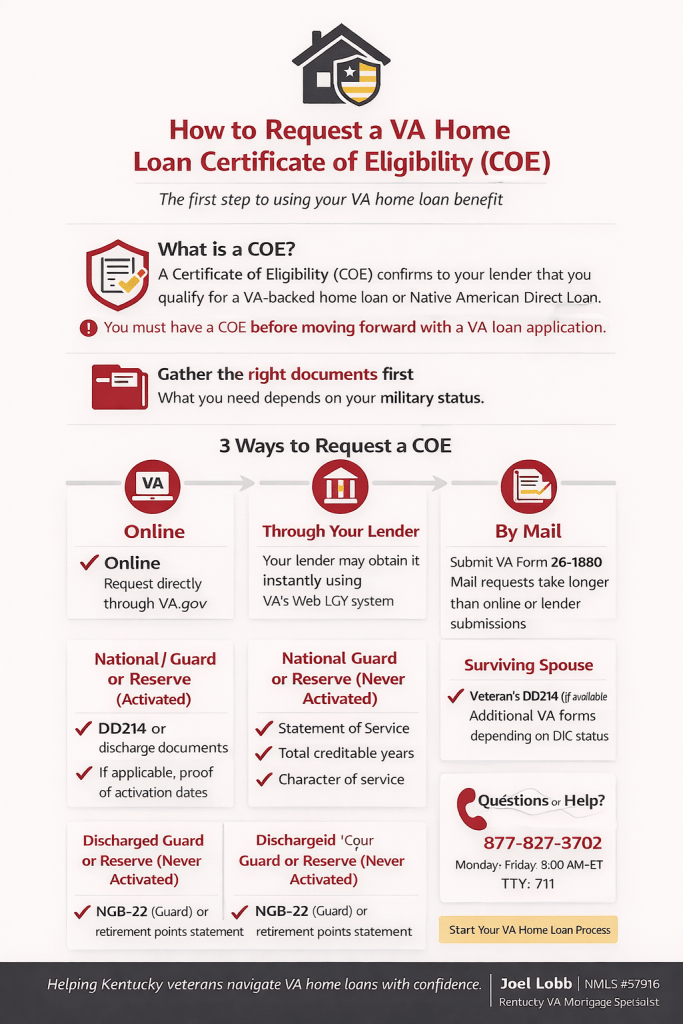
How to Request a VA Home Loan Certificate of Eligibility (COE)

A Certificate of Eligibility (COE) is the first step in getting a VA-backed home loan or Native American Direct Loan. The COE confirms to your lender that you qualify for the VA home loan benefit and are eligible to move forward with a VA mortgage.

Once your COE is issued, you can choose a loan type and continue through the rest of the VA loan application process.


How to Prepare Before You Request a COE

Before starting your COE request, gather the documents you’ll need. The required paperwork depends on your military service status.

Veteran

  • Copy of your discharge or separation papers (DD214)

Active-Duty Service Member

You’ll need a Statement of Service signed by your commander, adjutant, or personnel officer. The statement must include:

  • Your full name
  • Your Social Security number
  • Your date of birth
  • The date you entered active duty
  • The duration of any lost time
  • The name of the command providing the information

Current or Former Activated National Guard Member

  • Copy of your DD214 or other discharge documents
  • If applicable, proof of activation dates, such as:
    • DD214 showing qualifying 32 USC activation sections
    • An annual retirement points statement
    • DD220 with accompanying orders

Current or Former Activated Reserve Member

  • Copy of your DD214 or other discharge documents

Current National Guard or Reserve Member Who Has Never Been Activated

You’ll need a Statement of Service signed by your commander, adjutant, or personnel officer showing:

  • Your full name
  • Your Social Security number
  • Your date of birth
  • The date you entered duty
  • Your total number of creditable years of service
  • The duration of any lost time
  • The name of the command providing the information

Discharged National Guard Member Who Was Never Activated

  • Report of Separation and Record of Service (NGB Form 22) for each period of service
  • Retirement Points Statement (NGB Form 23) and proof of character of service

Discharged Reserve Member Who Was Never Activated

  • Copy of your latest annual retirement points statement
  • Proof of honorable service

Surviving Spouse

If you qualify as a surviving spouse, you’ll typically need the Veteran’s DD214 (if available). Additional VA forms may be required depending on whether you receive Dependency and Indemnity Compensation (DIC).


How to Request a COE

You can request a Certificate of Eligibility in one of three ways.

Option 1: Online

Request your COE directly through VA.gov. This is often the fastest option.

Option 2: Through Your Lender

Your lender may be able to obtain your COE instantly using the VA’s Web LGY system. Ask your lender if they can request the COE on your behalf.

Option 3: By Mail

Complete VA Form 26-1880 (Request for a Certificate of Eligibility) and mail it to the address listed on the last page of the form. Mail requests typically take longer than online or lender submissions.


What Happens After You Request a COE?

  • The VA reviews your request and issues a decision
  • You can check the status of your COE request online

Next Steps After Your COE Is Issued

Requesting a COE is only part of the VA loan process. After your COE is issued:

  • Your lender orders a VA appraisal to assess market value
  • Your lender reviews your income, credit, and documentation
  • If approved, a title company is selected and closing is scheduled

Questions About the VA Loan Process?

If you have questions your lender can’t answer, you can contact a VA home loan representative at 877-827-3702 (TTY: 711), Monday through Friday, 8:00 a.m. to 6:00 p.m. ET.


Kentucky VA Loan Assistance

If you’re buying a home in Kentucky, I can help you determine which documents apply to your service history and coordinate with your lender to request the COE when eligible.

Text or call: 502-905-3708
Joel Lobb – NMLS #57916

Informational only. Not affiliated with or acting on behalf of the U.S. Department of Veterans Affairs. Not a commitment to lend. Subject to credit approval and program guidelines. Kentucky only.

How to request a VA home loan Certificate of Eligibility (COE)

Learn how to request a VA home loan Certificate of Eligibility (COE). This is the first step in getting a VA-backed home loan or Native American Direct Loan. It confirms for your lender that you qualify for the VA home loan benefit.

1 How do I prepare before I start a COE request?

Select the description here that matches you best to find out what you’ll need.

You’ll need a copy of your discharge or separation papers (DD214).

You’ll need a statement of service—signed by your commander, adjutant, or personnel officer—showing:

  • Full name & Social Security number
  • Date of birth & Date you entered duty
  • Duration of any lost time
  • Name of the command providing the information

You’ll need a copy of your DD214 or other discharge documents.

Note: If you have 90+ days of active service (with 30 consecutive), provide a document showing activation date (DD214, annual point statement, or DD220 with orders).

You’ll need the Veteran’s discharge documents (DD214) if available.

If receiving DIC:

Submit VA Form 26-1817 (Request for Determination of Loan Guaranty Eligibility).

If NOT receiving DIC:

Submit VA Form 21P-534EZ, Marriage License, and Veteran’s Death Certificate.

2 How do I request a COE?

💻

Online

The fastest way to apply through the VA.gov portal.

🏦

Via Lender

Most lenders can access “Web LGY” to get it for you instantly.

✉️

By Mail

Fill out VA Form 26-1880 and mail to your regional center.

What happens next?

The VA will review your request and notify you of the decision. Once you have your COE, the lending process typically follows these steps:

VA Appraisal

The lender requests an assessment to estimate the house’s market value.

Review & Underwriting

Lenders review your credit, income, and the appraisal report.

Closing

Ownership is transferred at a title company or similar entity.

Questions about the loan process?

877-827-3702 | Mon-Fri 8am-6pm ET
function toggleAccordion(button) { const item = button.parentElement; const isActive = item.classList.contains(‘active’); // Close all items document.querySelectorAll(‘.accordion-item’).forEach(el => { el.classList.remove(‘active’); }); // Open clicked item if it wasn’t active if (!isActive) { item.classList.add(‘active’); } }